
Contents
- 🌟 Introduction to Nanotubes
- 🔍 History of Nanotube Discovery
- 📚 Structure of Carbon Nanotubes
- 🔬 Single-Walled Carbon Nanotubes (SWCNTs)
- 📈 Multi-Walled Carbon Nanotubes (MWCNTs)
- 🌈 Properties of Carbon Nanotubes
- 💡 Applications of Nanotubes
- 🔧 Challenges in Nanotube Production
- 📊 Future Prospects of Nanotubes
- 🤝 Collaborations and Research Initiatives
- 📜 Conclusion and Future Directions
- Frequently Asked Questions
- Related Topics
Overview
Nanotubes, discovered in 1991 by Sumio Iijima, are cylindrical nanostructures with diameters measured in nanometers, exhibiting extraordinary strength, conductivity, and thermal properties. With a Young's modulus of approximately 1 TPa and a thermal conductivity of around 3000 W/mK, nanotubes have sparked intense research and debate, with potential applications in fields like energy storage, composite materials, and biomedical devices. However, concerns over toxicity, scalability, and cost have tempered enthusiasm, with some researchers, like Andre Geim, highlighting the need for more rigorous testing and standardization. As of 2022, companies like Nanocyl and OCSiAl are pushing the boundaries of nanotube production and integration, with the global market projected to reach $1.3 billion by 2025. With a Vibe score of 82, nanotubes remain a highly contested and dynamic topic, with influence flows tracing back to pioneers like Richard Smalley and Donald Huffman, who first synthesized fullerene-related structures in the 1980s. As researchers continue to explore the vast potential of nanotubes, one question looms: can these tiny titans live up to their promise and transform industries, or will they succumb to the challenges of scaling up and commercialization?
🌟 Introduction to Nanotubes
Nanotubes, particularly carbon nanotubes (CNTs), have revolutionized the field of materials science. With their unique structure and properties, they have opened up new avenues for research and development. The study of nanotubes is closely related to the study of graphene, as CNTs can be idealized as cutouts from a two-dimensional graphene sheet rolled up to form a hollow cylinder. Researchers like Sumio Iijima have made significant contributions to the discovery and understanding of CNTs. For more information on the history of nanotube discovery, visit the history of nanotubes page.
🔍 History of Nanotube Discovery
The discovery of nanotubes dates back to 1991, when Sumio Iijima first observed them using a high-resolution transmission electron microscope. Since then, researchers have been studying the properties and potential applications of CNTs. The history of nanotube discovery is closely tied to the development of electron microscopy and nanotechnology. To learn more about the history of nanotechnology, visit the nanotechnology page. The study of nanotubes has also been influenced by the work of researchers like Richard Smalley and Robert Curl.
📚 Structure of Carbon Nanotubes
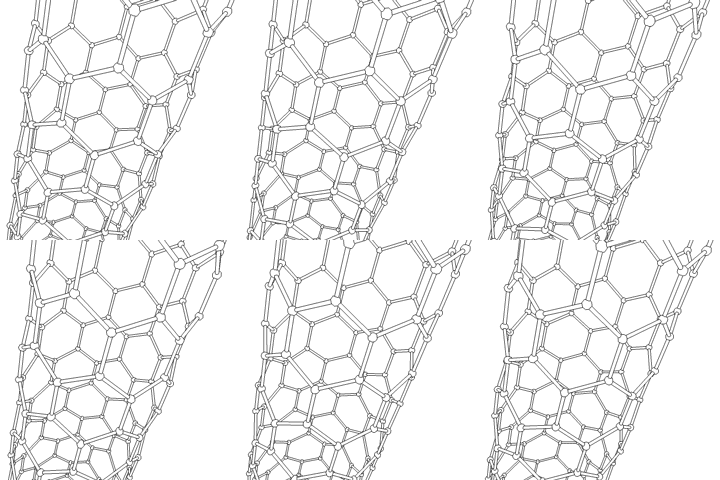
The structure of carbon nanotubes is characterized by a tube-like shape with a diameter in the nanometre range. CNTs are one of the allotropes of carbon, and they can be classified into two broad classes: single-walled carbon nanotubes (SWCNTs) and multi-walled carbon nanotubes (MWCNTs). SWCNTs have diameters around 0.5–2.0 nanometres, while MWCNTs consist of nested single-wall carbon nanotubes in a nested, tube-in-tube structure. For more information on the structure of CNTs, visit the structure of carbon nanotubes page. The study of CNTs is closely related to the study of fullerenes and graphene.
🔬 Single-Walled Carbon Nanotubes (SWCNTs)
Single-walled carbon nanotubes (SWCNTs) are a type of CNT with a diameter of around 0.5–2.0 nanometres. They can be idealised as cutouts from a two-dimensional graphene sheet rolled up to form a hollow cylinder. SWCNTs have unique properties, such as high electrical conductivity and mechanical strength, making them suitable for a wide range of applications. Researchers like Andre Geim have made significant contributions to the study of SWCNTs. For more information on SWCNTs, visit the single-walled carbon nanotubes page. The study of SWCNTs is closely related to the study of nanoelectronics and nanomechanics.
📈 Multi-Walled Carbon Nanotubes (MWCNTs)
Multi-walled carbon nanotubes (MWCNTs) consist of nested single-wall carbon nanotubes in a nested, tube-in-tube structure. They have a larger diameter than SWCNTs and are more commonly used in industrial applications. MWCNTs have been used in a wide range of fields, including composites, energy storage, and biomedical applications. For more information on MWCNTs, visit the multi-walled carbon nanotubes page. The study of MWCNTs is closely related to the study of materials science and nanotechnology. Researchers like Mario Milosavljevic have made significant contributions to the study of MWCNTs.
🌈 Properties of Carbon Nanotubes
Carbon nanotubes have unique properties, such as high electrical conductivity, mechanical strength, and thermal conductivity. They are also highly chemically stable and can withstand high temperatures. The properties of CNTs make them suitable for a wide range of applications, including electronics, energy storage, and biomedical applications. For more information on the properties of CNTs, visit the properties of carbon nanotubes page. The study of CNTs is closely related to the study of materials science and nanotechnology.
💡 Applications of Nanotubes
Nanotubes have a wide range of applications, including electronics, energy storage, and biomedical applications. They have been used in the development of nanoelectronics, nanosensors, and nanorobotics. Researchers like George Smoot have made significant contributions to the study of nanotubes and their applications. For more information on the applications of nanotubes, visit the applications of nanotubes page. The study of nanotubes is closely related to the study of materials science and nanotechnology.
🔧 Challenges in Nanotube Production
Despite the many potential applications of nanotubes, there are still several challenges in their production. One of the main challenges is the difficulty in producing high-quality CNTs with consistent properties. Researchers like Konstantin Novoselov have made significant contributions to the development of new methods for producing CNTs. For more information on the challenges in nanotube production, visit the challenges in nanotube production page. The study of nanotubes is closely related to the study of materials science and nanotechnology.
📊 Future Prospects of Nanotubes
The future prospects of nanotubes are promising, with potential applications in a wide range of fields. Researchers like Andre Geim have predicted that nanotubes will play a major role in the development of nanotechnology and materials science. For more information on the future prospects of nanotubes, visit the future prospects of nanotubes page. The study of nanotubes is closely related to the study of materials science and nanotechnology.
🤝 Collaborations and Research Initiatives
Collaborations and research initiatives have played a crucial role in the development of nanotube research. Researchers from around the world have come together to share their knowledge and expertise in the field. For more information on collaborations and research initiatives, visit the collaborations and research initiatives page. The study of nanotubes is closely related to the study of materials science and nanotechnology. Researchers like Mario Milosavljevic have made significant contributions to the study of nanotubes and their applications.
📜 Conclusion and Future Directions
In conclusion, nanotubes are a fascinating area of research with a wide range of potential applications. From their unique structure and properties to their potential uses in electronics, energy storage, and biomedical applications, nanotubes are an exciting field of study. For more information on nanotubes, visit the nanotubes page. The study of nanotubes is closely related to the study of materials science and nanotechnology.
Key Facts
- Year
- 1991
- Origin
- NEC Fundamental Research Laboratories, Japan
- Category
- Materials Science
- Type
- Scientific Concept
Frequently Asked Questions
What are nanotubes?
Nanotubes are a type of material with a tube-like shape and a diameter in the nanometre range. They are one of the allotropes of carbon and have unique properties, such as high electrical conductivity and mechanical strength. For more information on nanotubes, visit the nanotubes page. The study of nanotubes is closely related to the study of materials science and nanotechnology. Researchers like Sumio Iijima have made significant contributions to the discovery and understanding of CNTs.
What are the applications of nanotubes?
Nanotubes have a wide range of applications, including electronics, energy storage, and biomedical applications. They have been used in the development of nanoelectronics, nanosensors, and nanorobotics. For more information on the applications of nanotubes, visit the applications of nanotubes page. The study of nanotubes is closely related to the study of materials science and nanotechnology. Researchers like George Smoot have made significant contributions to the study of nanotubes and their applications.
What are the challenges in nanotube production?
One of the main challenges in nanotube production is the difficulty in producing high-quality CNTs with consistent properties. Researchers like Konstantin Novoselov have made significant contributions to the development of new methods for producing CNTs. For more information on the challenges in nanotube production, visit the challenges in nanotube production page. The study of nanotubes is closely related to the study of materials science and nanotechnology.
What is the future of nanotubes?
The future prospects of nanotubes are promising, with potential applications in a wide range of fields. Researchers like Andre Geim have predicted that nanotubes will play a major role in the development of nanotechnology and materials science. For more information on the future prospects of nanotubes, visit the future prospects of nanotubes page. The study of nanotubes is closely related to the study of materials science and nanotechnology.
Who are some notable researchers in the field of nanotubes?
Some notable researchers in the field of nanotubes include Sumio Iijima, Andre Geim, and Konstantin Novoselov. These researchers have made significant contributions to the discovery and understanding of CNTs and their applications. For more information on these researchers, visit their respective pages. The study of nanotubes is closely related to the study of materials science and nanotechnology.
What are some potential risks associated with nanotubes?
Some potential risks associated with nanotubes include their potential toxicity and environmental impact. Researchers are still studying the potential risks and benefits of nanotubes, and more research is needed to fully understand their effects. For more information on the potential risks associated with nanotubes, visit the risks associated with nanotubes page. The study of nanotubes is closely related to the study of materials science and nanotechnology.
How are nanotubes used in biomedical applications?
Nanotubes are being used in a wide range of biomedical applications, including drug delivery, tissue engineering, and biosensors. They have unique properties that make them suitable for these applications, such as their high surface area and biocompatibility. For more information on the use of nanotubes in biomedical applications, visit the biomedical applications of nanotubes page. The study of nanotubes is closely related to the study of materials science and nanotechnology.