
Contents
Overview
The genesis of the F-117 Nighthawk can be traced to the intense Cold War competition, where the threat of increasingly sophisticated Soviet SAM systems necessitated a radical rethink of air combat survivability. The F-117's existence was initially a secret due to the Cold War competition. In 1976, the DARPA awarded Lockheed a contract for the Have Blue project, a crucial technology demonstrator that proved the viability of low-observable (stealth) principles. The Have Blue program validated the F-117's revolutionary stealth technology. This success paved the way for Lockheed's Skunk Works division to develop a full-scale aircraft, with the first prototype taking flight on November 18, 1981, at the clandestine Groom Lake facility in Nevada. The first production F-117 was delivered in 1982, and the aircraft achieved initial operational capability in October 1983, initially based at the Tonopah Test Range Airport. Its existence was a closely guarded secret, officially acknowledged only in 1988, a testament to the groundbreaking nature of its stealth capabilities.
⚙️ How It Works
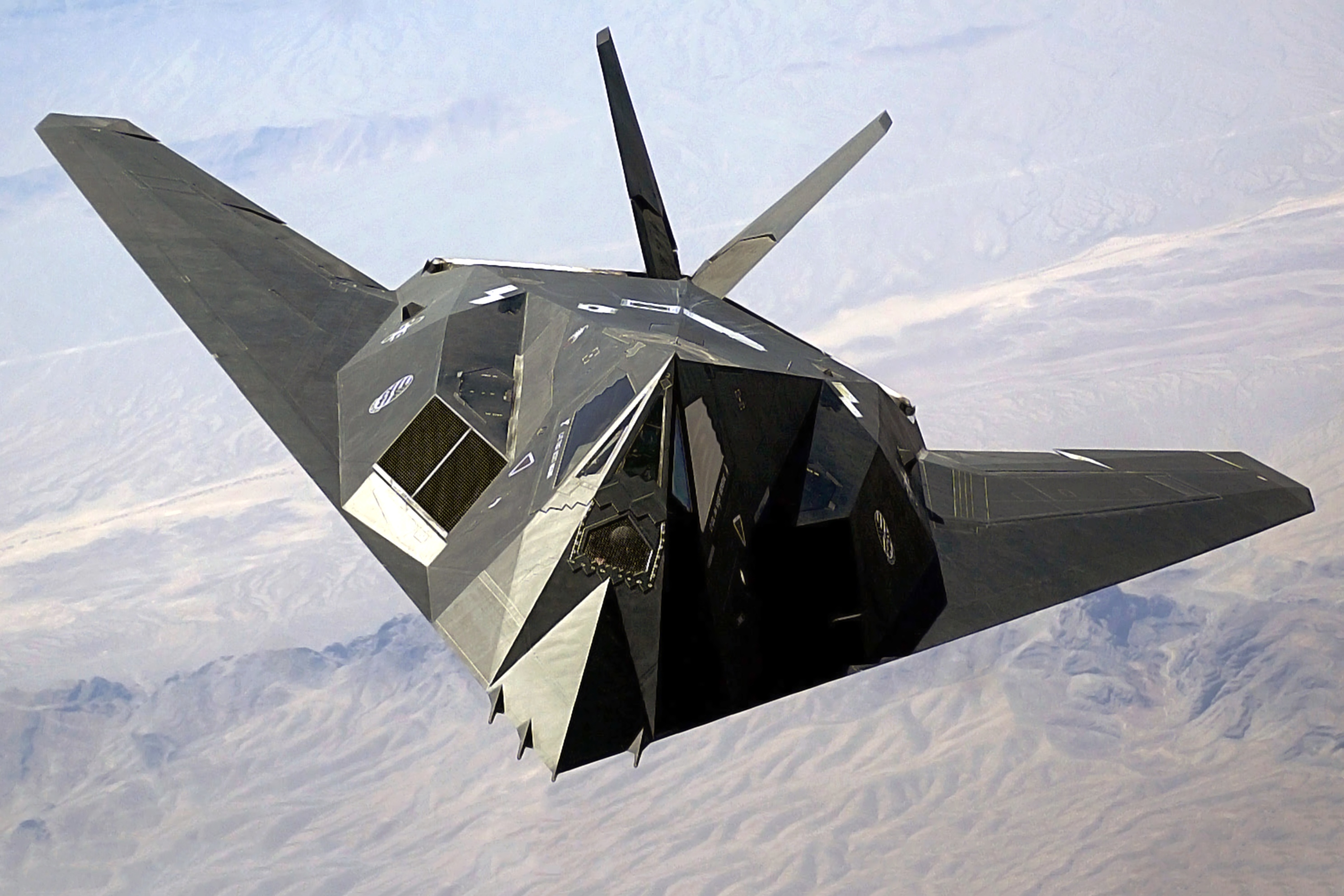
The F-117's stealth is not achieved through a single technology but a combination of design and materials. Its most striking feature is its faceted airframe, composed of flat surfaces angled to deflect radar waves away from the source, rather than reflecting them back. This design, inspired by the theoretical work of Harry Rumsey and the practical application by Denys Overholser, deliberately sacrificed aerodynamic efficiency for radar cross-section reduction. The F-117's engines are buried deep within the fuselage to minimize infrared signature. Radar-absorbent materials (RAM) were applied to its skin, further reducing its detectability. These elements combined to give the F-117 an extremely low radar cross-section, making it appear on radar as small as a bird or a distant insect, a revolutionary feat for its time.
📊 Key Facts & Numbers
The F-117 program saw the production of 64 operational aircraft, with five prototypes preceding them. The first production F-117 was delivered in 1982, and initial operating capability was declared in October 1983. Throughout its service life, the F-117 fleet accumulated over 5,000 combat sorties, with approximately 1,270 combat missions flown. During the 1991 Gulf War, F-117s accounted for an estimated 40% of the precision-guided munitions dropped by coalition forces, hitting over 1,600 targets. The aircraft's operational cost per flight hour was approximately $5,500. The entire fleet was retired by April 2008, with the final flight occurring on April 22, 2008, marking the end of an era for the pioneering stealth platform.
👥 Key People & Organizations
The F-117 program was a monumental undertaking involving numerous key individuals and organizations. Lockheed, specifically its advanced development division Skunk Works, led by figures like Ben Rich (who succeeded Kelly Johnson as director), was responsible for its design and production. DARPA played a pivotal role in funding and overseeing the initial stealth research through the Have Blue program. Key engineers and designers, including Denys Overholser, were instrumental in translating theoretical stealth principles into a functional aircraft design. The USAF was the sole operator of the F-117, integrating it into its tactical strike capabilities and maintaining its operational readiness. The aircraft's development was a classified black project for years, highlighting the secrecy surrounding its creation.
🌍 Cultural Impact & Influence
The F-117 Nighthawk's impact on military aviation and popular culture is profound. It irrevocably shifted the paradigm of air warfare, proving that stealth was not just a theoretical concept but a deployable reality. Its success directly spurred the development of subsequent stealth aircraft, such as the B-2 Spirit bomber and the F-22 Raptor fighter. The Nighthawk's angular, almost alien appearance captured the public imagination, making it a recurring icon in films, video games, and aviation literature, often symbolizing cutting-edge technology and covert operations. Its operational debut in the Gulf War demonstrated a tangible advantage in penetrating enemy defenses, influencing military procurement strategies globally and initiating a stealth arms race.
⚡ Current State & Latest Developments
Although officially retired from USAF service in 2008, the F-117 Nighthawk continues to fly. NASA acquired several retired F-117 airframes for research purposes, utilizing them for flight dynamics and sensor testing, with one example being used in a project at Dryden Flight Research Center (now Armstrong Flight Research Center). These 'gliding testbeds' allow researchers to explore advanced aerodynamic concepts and sensor integration without the constraints of a classified military program. While no longer performing combat missions, the F-117's continued presence in specialized research underscores its enduring value as a platform for technological advancement, even decades after its combat debut.
🤔 Controversies & Debates
The F-117's existence and operational success were initially met with skepticism and outright denial by the USAF, leading to a significant controversy regarding its public acknowledgment. The prolonged secrecy surrounding the aircraft, while strategically beneficial, also fueled conspiracy theories and public speculation. Furthermore, the F-117's design, optimized for stealth over speed and maneuverability, led to debates about its true combat effectiveness compared to more conventional, albeit less stealthy, aircraft. The downing of one F-117 over Serbia in 1999 during the Kosovo War by a Soviet-era SAM system sparked discussions about the limitations of stealth technology and the evolving nature of air defense systems, challenging the notion of complete invulnerability.
🔮 Future Outlook & Predictions
The legacy of the F-117 ensures its influence will persist. While the aircraft itself is retired from frontline service, the foundational stealth technologies it pioneered are now integral to virtually all modern advanced combat aircraft, including the F-35 Lightning II and the J-20. Future developments in stealth will likely focus on multi-spectral signature reduction (beyond radar), adaptive camouflage, and integration with artificial intelligence for enhanced mission planning and execution. The F-117's success validates the long-term strategic advantage of low-observability, suggesting that future air dominance will continue to rely heavily on technologies that minimize detectability across various sensor spectrums, potentially leading to even more sophisticated 'invisible' platforms.
💡 Practical Applications
The primary practical application of the F-117 Nighthawk was its role as a dedicated stealth attack aircraft, designed for deep penetration into heavily defended enemy airspace to strike high-value targets. Its missions typically involved precision bombing of command and control centers, air defense installations, and strategic infrastructure, often under the cover of darkness. The aircraft's ability to operate with a significantly reduced risk of detection allowed for missions that would have been impossible for conventional aircraft. Beyond its combat role, retired F-117 airframes are now utilized by NASA for advanced aerospace research, contributing to the development of future flight control systems and sensor technologies at facilities like Armstrong Flight Research Center.
Key Facts
- Category
- technology
- Type
- topic