
Contents
Overview
The zoetrope's genesis can be traced back to the early 19th century, a period buzzing with optical innovations. While William George Horner, an English inventor, is credited with patenting a device in 1834 that bore a strong resemblance, the concept was independently conceived and refined by others. Horner's design featured a revolving cylinder with internal slits and a strip of images. The device that most closely resembles the modern zoetrope, with its interchangeable paper or metal strips, was popularized by Edward William Lane. Its lineage can be directly linked to earlier stroboscopic toys like the phenakistoscope (invented by Joseph Plateau) and the zootrope (invented by Simon von Stampfer), all exploring the same fundamental principle of animated illusion.
⚙️ How It Works
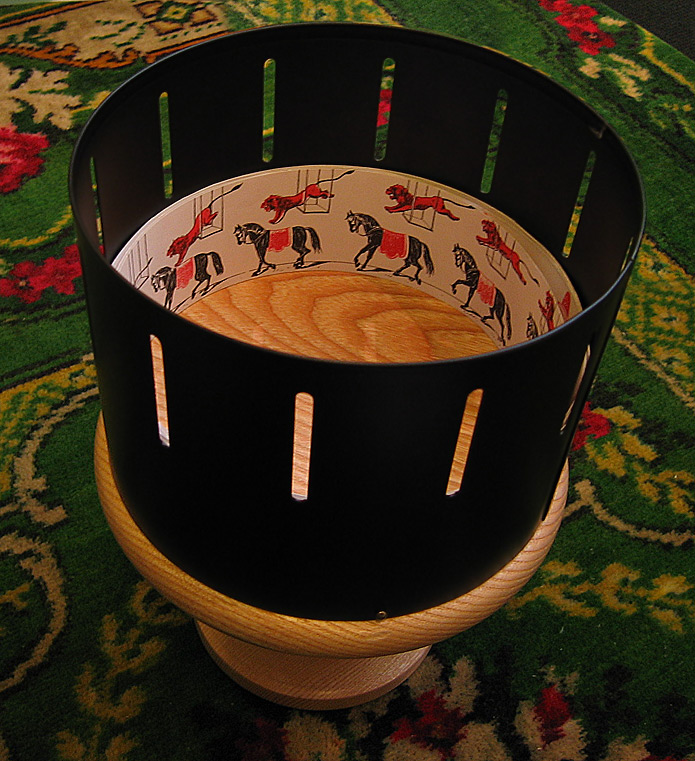
The magic of the zoetrope lies in its elegant mechanical simplicity, exploiting the phenomenon of persistence of vision. The device is a cylinder, typically made of metal or cardboard, with a series of evenly spaced vertical slits around its circumference. Inside the cylinder, a removable band holds a sequence of images, each depicting a slightly different phase of a motion. When the cylinder is spun, the viewer looks through the slits. Each slit momentarily reveals an image, and the rapid succession of these images, combined with the brief moments of darkness between them, tricks the brain into perceiving continuous motion. The speed of rotation is critical; too slow and the images appear as distinct frames, too fast and they blur into an indistinguishable mass. This precise interplay between light, darkness, and sequential imagery is what animates the static drawings, creating the illusion of life.
📊 Key Facts & Numbers
The zoetrope, though a historical artifact, represents a significant milestone in visual media. The zoetrope's legacy is not just in its physical form but in the enduring principle of creating motion from stillness. Its enduring appeal lies in its elegant simplicity and its profound demonstration of how our eyes perceive movement from still frames.
👥 Key People & Organizations
The invention and popularization of the zoetrope involved several key figures. William George Horner, an English inventor, is credited with patenting a similar device, the 'Daedaleum,' in 1834, laying crucial groundwork. Edward William Lane is often cited for his role in refining the design and promoting its concept. Other significant figures in the development of optical toys that preceded or paralleled the zoetrope include Joseph Plateau and Simon von Stampfer, inventors of the phenakistoscope and stroboscope respectively, whose work explored similar principles of stroboscopic animation.
🌍 Cultural Impact & Influence
The zoetrope's cultural impact is undeniable, serving as a direct precursor to motion pictures and modern animation. The zoetrope became a symbol of Victorian ingenuity and entertainment, appearing in literature and art as a representation of wonder and nascent technology. Its aesthetic, a spinning cylinder of flickering images, remains iconic in discussions of animation history and the origins of cinema.
⚡ Current State & Latest Developments
While the original zoetrope is largely a historical artifact, its principles continue to be explored and adapted. Contemporary artists and animators often create modern zoetropes, sometimes using 3D printed components or digital displays to generate new animations. These contemporary versions, often exhibited in galleries or as interactive installations, keep the spirit of the zoetrope alive. Furthermore, the underlying technology of sequential image display is fundamental to all digital screens, from YouTube to Netflix. The zoetrope's legacy is not just in its physical form but in the enduring principle of creating motion from stillness, a concept that continues to evolve with technologies like virtual reality and augmented reality.
🤔 Controversies & Debates
The primary 'controversy' surrounding the zoetrope isn't one of heated debate but rather of historical attribution and precise lineage. While william-george-horner patented a device in 1834 that bore a strong resemblance, the commercial success and widespread recognition of the zoetrope are largely tied to Milton Bradley's 1866 product. Some historical accounts might emphasize Horner's earlier patent, while others focus on the toy's market impact. Additionally, the zoetrope exists in a lineage of optical toys, leading to discussions about which invention was truly the 'first' or most influential, with the phenakistoscope and zootrope often cited as close relatives or precursors, making precise claims of sole invention complex.
🔮 Future Outlook & Predictions
The future of the zoetrope, in its purest form, is likely to remain within the realm of historical appreciation and artistic reinterpretation. However, the core principle of sequential image animation continues to be a driving force in digital media. We can anticipate further artistic explorations using the zoetrope's aesthetic, perhaps integrating advanced projection mapping or interactive elements. The educational value of the zoetrope will also persist, serving as a tangible tool for teaching the fundamentals of animation and visual perception in schools and museums. As technology advances, we might see digital simulations or even holographic versions that pay homage to the original spinning cylinder, demonstrating that the illusion of motion, once captured by a simple rotating drum, remains a captivating human pursuit.
💡 Practical Applications
The most direct practical application of the zoetrope today is as an educational tool and an artistic medium. Museums and science centers often feature zoetropes as exhibits to demonstrate the principles of animation and optics to visitors, particularly children. Artists and animators utilize the zoetrope as a unique canvas for creating short, looping animations, often exploring themes of memory, time, or motion itself. Beyond these direct uses, the zoetrope's historical significance lies in its role as a foundational technology. It provided a tangible, accessible demonstration of animation principles that directly informed the development of subsequent technologies, ultimately leading to the sophisticated visual storytelling we see in Pixar films and Netflix series today. Its invention paved the way for understanding how to create the illusion of life from static images.
Key Facts
- Category
- technology
- Type
- topic