
Contents
Overview
Treaty law governs the creation, interpretation, and enforcement of formal agreements between sovereign states and other subjects of international law. At its heart, it's the legal framework that allows nations to cooperate, resolve disputes, and establish norms on everything from trade and security to environmental protection and human rights. The cornerstone of modern treaty law is the Vienna Convention on the Law of Treaties (VCLT), adopted in 1969, which codifies centuries of customary practice and provides a universally recognized set of rules for treaty-making. However, the VCLT's definition of a treaty, strictly between states and in writing, has faced challenges and interpretations, particularly with the rise of non-state actors and informal agreements. Understanding treaty law is crucial for navigating international relations, as treaties represent the most formal expression of a state's consent to be bound by international obligations, shaping global governance and impacting billions of lives.
🎵 Origins & History
The genesis of treaty law stretches back to antiquity, with some of the earliest recorded agreements appearing in ancient Mesopotamia. Agreements between Ramesses II of Egypt and Hattusili III of the Hittite Empire around 1259 BCE, for example, established peace and mutual defense. Throughout the Roman Empire, treaties were instrumental in managing relations with client states and foreign powers, often codified in public inscriptions. The medieval period saw the proliferation of treaties related to dynastic marriages, territorial claims, and religious alliances, though their enforcement was often precarious. The Peace of Westphalia in 1648, ending the Thirty Years' War, is a watershed moment, widely considered to have cemented the principle of state sovereignty and established a more modern framework for international diplomacy and treaty-making, laying the groundwork for the systematic development of treaty law as we know it today.
⚙️ How It Works
Treaty law operates through a structured process governed by principles of consent, good faith, and pacta sunt servanda (agreements must be kept). A treaty typically begins with negotiation, where states or authorized representatives discuss and agree upon terms. This is followed by signature, which often signifies an intent to be bound, and then ratification, a formal act by which a state expresses its consent to be legally bound, usually through domestic legislative approval. Entry into force occurs when the required number of states have expressed their consent. Interpretation is guided by rules outlined in the VCLT, emphasizing the ordinary meaning of terms in their context and in light of the treaty's object and purpose. Amendments and modifications require the consent of all parties, while termination or withdrawal is permissible under specific conditions, such as mutual agreement or material breach.
📊 Key Facts & Numbers
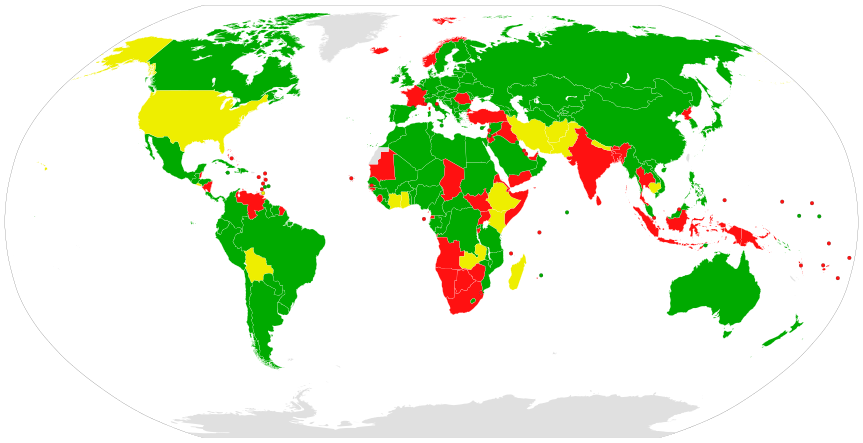
As of February 2026, the Vienna Convention on the Law of Treaties (VCLT) has been ratified by 118 states, representing a significant portion of the international community. The United Nations Treaty Collection houses over 60,000 bilateral and multilateral treaties deposited with the Secretary-General. The global treaty market, encompassing all international agreements, is immeasurable but underpins trillions of dollars in global trade and investment annually. For instance, the World Trade Organization (WTO) agreements alone govern over 98% of global trade. The average lifespan of a treaty can range from a few years to centuries, with some foundational agreements like the UN Charter (1945) remaining in force for over 75 years.
👥 Key People & Organizations
While no single individual 'invented' treaty law, key figures and institutions have shaped its evolution. The United Nations plays a central role through its codification efforts and its role as a depositary for numerous treaties. The International Court of Justice (ICJ) and the International Criminal Court (ICC) frequently interpret and apply treaty law in their judgments. Scholars like Hersch Lauterpacht and Manuel Ruda were instrumental in the drafting of the VCLT. Organizations such as the International Law Commission (ILC) have been crucial in preparing draft articles that form the basis of international conventions, including the VCLT itself, ensuring a consistent and authoritative development of treaty principles.
🌍 Cultural Impact & Influence
Treaty law profoundly influences global governance, shaping international cooperation on issues ranging from climate change (e.g., the Paris Agreement) to arms control (e.g., the Nuclear Non-Proliferation Treaty). It provides the legal architecture for international organizations like the World Health Organization (WHO) and the International Monetary Fund (IMF). The widespread ratification of treaties fosters a sense of shared legal responsibility and predictability in international affairs. Furthermore, treaty law impacts domestic legal systems, as states often incorporate treaty obligations into their national laws, influencing policy decisions and judicial interpretations, thereby extending the reach of international agreements into the daily lives of citizens worldwide.
⚡ Current State & Latest Developments
In the current geopolitical climate, treaty law is experiencing dynamic shifts. The rise of digital diplomacy and the increasing use of online platforms for treaty negotiation and dissemination, accelerated by events like the COVID-19 pandemic, are transforming practice. There's a growing focus on the enforceability of treaties, particularly in areas like human rights and environmental law, with innovative dispute resolution mechanisms being explored. The role of non-state actors, including multinational corporations and international non-governmental organizations (INGOs), in treaty-making processes is also a subject of ongoing discussion and development. Furthermore, the impact of unilateral actions and challenges to multilateralism by certain states continue to test the resilience and application of established treaty principles in the 21st century.
🤔 Controversies & Debates
A significant controversy in treaty law revolves around the definition of a 'treaty' itself, particularly concerning agreements not in writing or those involving non-state actors. The VCLT's strict definition has been criticized for being too narrow in an era of complex international interactions. Another debate concerns the balance between state sovereignty and international obligations, with some states asserting that domestic law should always take precedence over treaty commitments. The interpretation of treaty provisions, especially in rapidly evolving fields like technology and cybersecurity, also presents challenges, leading to disputes over whether a treaty's original intent still applies. The question of whether certain parts of the VCLT reflect customary international law, even for non-parties like the United States, remains a point of contention and legal analysis.
🔮 Future Outlook & Predictions
The future of treaty law is likely to be shaped by technological advancements and evolving global challenges. We can anticipate a greater formalization of digital treaties and the use of blockchain for secure record-keeping and verification of treaty compliance. The increasing urgency of global issues like climate change and pandemics will necessitate more complex, multi-stakeholder treaties involving a wider array of actors beyond just states. There may also be a push for more robust enforcement mechanisms, potentially involving international tribunals with broader jurisdiction or innovative dispute resolution processes. The challenge will be to adapt the traditional framework of treaty law to remain relevant and effective in a world characterized by rapid change and interconnectedness, ensuring that treaties continue to serve as reliable instruments of global cooperation.
💡 Practical Applications
Treaty law has myriad practical applications across virtually every sector of international engagement. Trade agreements, such as the United States-Mexico-Canada Agreement, facilitate commerce and investment by setting rules for tariffs, quotas, and market access. Environmental treaties, like the Kyoto Protocol and its successor, the Paris Agreement, establish targets for reducing greenhouse gas emissions and protecting biodiversity. Security treaties, including NATO's collective defense pact, aim to ensure peace and stability through mutual defense commitments. Human rights treaties, such as the International Covenant on Civil and Political Rights, set standards for the treatment of individuals and provide mechanisms for accountability. Even seemingly technical agreements, like aviation standards
Key Facts
- Category
- law
- Type
- topic