
Contents
Overview
The genesis of the sewing machine lies in the late 18th century, a period ripe with mechanical innovation. While Thomas Saint patented a design in 1790 for a machine intended for stitching leather and canvas, it was never successfully manufactured and its exact function remains debated. The true lineage of the modern sewing machine often traces back to the 1830s and 1840s. Barthélemy Thimonnier of France developed a chain-stitch machine around 1830, which was used to produce uniforms, though his workshop was reportedly destroyed by fearful tailors who saw it as a threat to their livelihoods. In the United States, Walter Hunt patented a lockstitch machine in 1834, but due to financial difficulties, he never commercialized it. The breakthrough for widespread adoption came with Elias Howe, who patented a lockstitch machine in 1846 featuring a needle with an eye at the point and a shuttle to form the lockstitch, a design that closely resembles modern machines. Howe's patent battles and eventual success in licensing his invention laid crucial groundwork for the burgeoning industry.
⚙️ How It Works
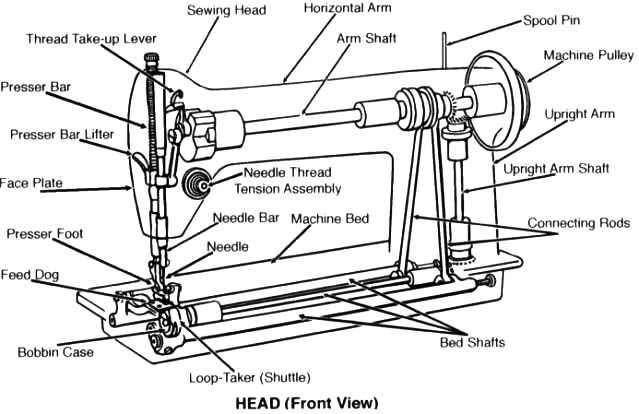
At its core, a sewing machine automates the process of creating stitches. Most modern machines utilize a lockstitch mechanism, which involves two threads: one from the needle and another from a bobbin beneath the fabric. The needle pierces the fabric, carrying the upper thread down, while the bobbin's thread is caught by a rotating hook mechanism and interlaced with the upper thread, forming a secure stitch. The fabric is advanced between stitches by a feed-dog mechanism, which grips and pulls the material forward incrementally. Users control the machine's speed via a foot pedal or handwheel, and select stitch types and patterns through dials or digital interfaces. Variations exist, such as chain stitch machines, which use a single thread to create a less durable but more flexible stitch, often seen in garment manufacturing.
📊 Key Facts & Numbers
The global sewing machine market is substantial, with projections to reach over $10 billion by 2030, indicating steady growth. Domestic sewing machines account for roughly 60% of this market, driven by the DIY and crafting boom. Industrial sewing machines, however, represent a significant portion of revenue due to their specialized nature and higher price points, with some high-speed industrial units capable of performing up to 5,000 stitches per minute. The Singer Corporation, one of the oldest and most recognizable brands, has sold over 150 million machines since its founding in 1851. The average cost of a basic home sewing machine ranges from $150 to $400, while advanced computerized models can exceed $2,000.
👥 Key People & Organizations
Several key figures and organizations shaped the sewing machine's trajectory. Elias Howe's patent and subsequent legal battles were pivotal in establishing the lockstitch mechanism. Isaac Singer significantly improved upon Howe's design, introducing the first practical, mass-produced machine with a vertical oscillating needle and a treadle-powered base, and his Singer Corporation became a dominant force. Barthélemy Thimonnier's earlier chain-stitch machine, though less impactful commercially, represents an important precursor. Walter Hunt's early lockstitch patent also deserves mention. Beyond inventors, companies like Janome, Brother Industries, and Pfaff have been instrumental in driving innovation and market accessibility, particularly in the domestic and specialized industrial sectors.
🌍 Cultural Impact & Influence
The sewing machine's impact on culture and society is profound. It democratized garment creation, moving it from the exclusive domain of skilled tailors to the home, fostering a culture of DIY and personal expression through fashion. The efficiency gains it provided fueled the growth of the fast-fashion industry, making clothing more affordable and accessible but also contributing to environmental concerns. Historically, it empowered women, offering them opportunities for income generation both within the home and in factory settings, though often under harsh conditions. The iconic image of the sewing machine became a symbol of domesticity and industry, appearing in literature and art. Its presence in households worldwide cemented its status as a fundamental appliance.
⚡ Current State & Latest Developments
The sewing machine landscape in 2024 is increasingly digital. Computerized models with touchscreens, automated thread cutters, and built-in embroidery designs are now standard for mid-to-high-end domestic machines. Connectivity is also emerging, with some machines offering Wi-Fi capabilities to download new patterns or connect with companion apps for tutorials and diagnostics. In the industrial sector, automation continues to advance, with robots and AI-powered systems handling complex assembly tasks in large-scale manufacturing, particularly in countries like China and Vietnam. Innovations in 3D printing are also beginning to intersect with textile manufacturing, hinting at future possibilities for on-demand, customized garment production.
🤔 Controversies & Debates
Debates surrounding sewing machines often center on labor practices and environmental impact. The historical exploitation of garment workers, particularly women, in factories powered by early sewing machines continues to be a concern, with ongoing discussions about fair wages and working conditions in the global garment industry. The rise of fast fashion, enabled by efficient sewing technology, faces criticism for its contribution to textile waste and environmental degradation. Furthermore, the debate over the 'maker movement' and the resurgence of home sewing often pits traditional craft against mass production, questioning the true accessibility and sustainability of both approaches.
🔮 Future Outlook & Predictions
The future of sewing machines points towards greater integration with digital technologies and advanced manufacturing. We can anticipate machines with enhanced AI capabilities for stitch optimization, predictive maintenance, and even automated pattern adjustments based on fabric type. The convergence with 3D printing could lead to entirely new methods of garment construction, potentially enabling hyper-personalized clothing produced on demand. In industrial settings, the push for greater automation and robotics will likely continue, aiming for fully autonomous garment factories. The challenge will be to balance these technological advancements with ethical considerations regarding labor and environmental sustainability, ensuring that future innovations benefit both consumers and producers.
💡 Practical Applications
Sewing machines have a vast array of practical applications. Domestically, they are used for clothing repair, alterations, and the creation of custom garments, home décor items like curtains and upholstery, and various crafts such as quilting and embroidery. Industrially, specialized machines are crucial for mass production in the apparel sector, footwear manufacturing, upholstery for furniture and automotive interiors, sail making, and even in specialized fields like medical textiles for producing surgical gowns and bandages. Advanced machines are also employed in technical textile applications, such as creating durable gear for outdoor activities or reinforcing materials for aerospace components.
Key Facts
- Category
- technology
- Type
- topic