
Contents
Overview
The formal study of meaning, semantics, traces its intellectual lineage back to ancient Greek philosophers like Aristotle, who grappled with the relationship between words and the concepts they represented. Modern linguistics began to systematically dissect meaning in the late 19th and early 20th centuries, with figures like Gottlob Frege laying groundwork in formal semantics by distinguishing between sense and reference. The structuralist movement, particularly through Ferdinand de Saussure's work on the arbitrary nature of the signifier-signified relationship, further cemented semantics as a distinct field. Early 20th-century philosophers of language, such as W.V.O. Quine, challenged foundational assumptions, sparking ongoing debates about meaning and reference that continue to shape the discipline.
⚙️ How It Works
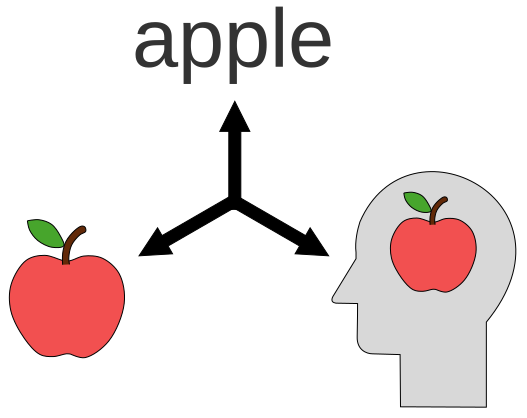
At its core, semantics examines meaning at various levels. Lexical semantics focuses on the meaning of individual words, exploring concepts like polysemy (multiple related meanings) and homonymy (words that sound or are spelled the same but have unrelated meanings). Compositionality is a key principle in phrasal semantics, positing that the meaning of a complex expression is determined by the meanings of its constituent parts and the rules by which they are combined. Formal semantics employs tools from logic and mathematics to model meaning precisely, often distinguishing between an expression's 'sense' (its conceptual content) and its 'reference' (the entity it points to in the real world). This rigorous approach is vital for computational linguistics and artificial intelligence.
📊 Key Facts & Numbers
The WordNet database, developed at Princeton University, contains over 150,000 English words organized into sets of synonyms called synsets, illustrating the sheer scale of lexical relationships.
👥 Key People & Organizations
Pioneers in the field include Gottlob Frege, whose work on sense and reference in the late 19th century is foundational to formal semantics. Alfred Tarski developed a highly influential theory of truth and meaning in formal languages. Noam Chomsky, while primarily known for syntax, also contributed significantly to semantic theory, particularly through his concept of generative grammar and the idea of semantic roles. Charles J. Fillmore developed frame semantics, focusing on how meaning is understood within conceptual frameworks. Organizations like the Linguistic Society of America and the Association for Computational Linguistics are central hubs for semantic research.
🌍 Cultural Impact & Influence
Semantics permeates every aspect of culture, from the persuasive power of advertising slogans to the emotional resonance of poetry. The interpretation of literature, the clarity of legal statutes, and the effectiveness of political rhetoric all hinge on semantic understanding. The development of natural language processing (NLP) by companies like Google and Meta is a direct application of semantic principles, enabling machines to understand and generate human language. Even everyday communication relies on shared semantic understanding; misunderstandings often arise from differing interpretations of word meanings or contextual cues, highlighting semantics' role in social cohesion.
⚡ Current State & Latest Developments
The field is currently experiencing a surge driven by advances in machine learning and deep learning. Researchers are increasingly focusing on cross-lingual semantics to bridge communication gaps and on embodied semantics, exploring how physical experience shapes linguistic meaning. The integration of semantics with cognitive science and neuroscience is also a rapidly developing frontier, seeking to understand the biological underpinnings of meaning.
🤔 Controversies & Debates
A persistent debate in semantics concerns the nature of meaning itself: is it purely conventional and arbitrary, as Saussure suggested, or are there inherent, perhaps even universal, semantic structures? The extent to which meaning is context-dependent versus context-independent is another major point of contention. Furthermore, the challenge of ambiguity in language — how to computationally resolve multiple possible meanings — remains a significant hurdle for AI. The philosophical question of whether machines can truly 'understand' meaning, or merely process symbols according to rules, as explored by John Searle's Chinese Room argument, continues to fuel debate.
🔮 Future Outlook & Predictions
The future of semantics is inextricably linked with the advancement of AI. We can expect more sophisticated LLMs capable of deeper contextual understanding and more accurate sentiment analysis. The development of universal translators that go beyond literal word-for-word conversion to capture true semantic intent is a likely outcome. Furthermore, research into explainable AI will necessitate clearer semantic models to understand how AI arrives at its interpretations. Semantics will also play a crucial role in developing more intuitive human-computer interaction interfaces, moving beyond command-based systems to truly conversational agents.
💡 Practical Applications
Semantics is not just an academic pursuit; it has profound practical applications. In search engines like Google, semantic understanding allows for more relevant search results by grasping the intent behind queries, not just keywords. Customer service chatbots and virtual assistants rely heavily on semantic analysis to understand user requests and provide appropriate responses. In legal tech, semantic tools can analyze contracts for specific clauses and potential risks. Bioinformatics uses semantic technologies to interpret complex biological data, and in EdTech, personalized learning platforms leverage semantic analysis to tailor content to individual student needs.
Key Facts
- Category
- linguistics
- Type
- concept