
Contents
- 🔭 What Exactly IS a Refractor Telescope?
- 🌟 Who Should Buy a Refractor?
- ⚙️ How Does It Work? The Optics Explained
- 📏 Key Features to Look For
- 💰 Pricing Tiers: From Beginner to Pro
- 🆚 Refractors vs. Reflectors: The Great Debate
- 🛠️ Maintenance & Care: Keeping It Sharp
- 🚀 Where to Buy & Getting Started
- Frequently Asked Questions
- Related Topics
Overview
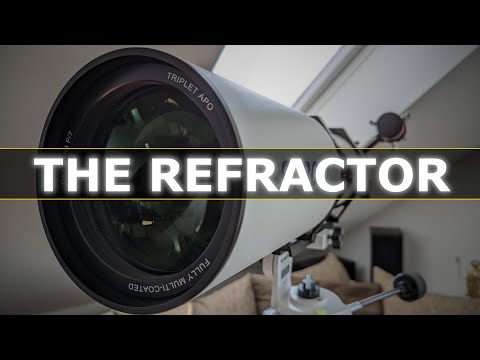
A refractor telescope, at its heart, is a light-gathering instrument that uses lenses to form an image. Unlike its reflector cousin, it employs an objective lens at the front, which bends (refracts) light to a focal point. This design has been the bedrock of astronomical observation since its inception, with early pioneers like Galileo using rudimentary versions to chart the heavens. They are celebrated for delivering crisp, high-contrast views, making them ideal for observing planets, the Moon, and double stars. The sealed tube design also means less dust and air disturbance inside, contributing to image clarity. For many, the elegance and simplicity of a refractor represent the quintessential telescope experience.
🌟 Who Should Buy a Refractor?
Refractors are a fantastic choice for beginners and seasoned astronomers alike, though their strengths lean towards specific observational goals. If your passion lies in detailed planetary studies, lunar features, or separating close binary stars, a refractor will likely satisfy. Their ease of use and minimal maintenance also make them attractive for those who want to spend more time observing and less time fiddling. While larger refractors can be quite expensive, smaller, well-made models offer an accessible entry point into serious astronomical pursuits. They are also favored by astrophotographers focusing on brighter, high-magnification targets like planets, where their sharp optics shine. Consider a refractor if you prioritize image quality and simplicity over sheer aperture for deep-sky objects.
⚙️ How Does It Work? The Optics Explained
The magic of a refractor lies in its objective lens, typically a compound lens made of two or more elements. This objective lens gathers light from distant celestial objects and bends it inward, converging it to a focal point. The light then passes through an eyepiece, which magnifies the resulting image for your eye. The quality of the lens elements, their material (like Extra-low Dispersion glass), and how they are ground and polished are critical to minimizing optical aberrations such as chromatic aberration (color fringing). The focal length of the objective lens, combined with the eyepiece's focal length, determines the telescope's magnification. Understanding this basic optical path is key to appreciating the engineering behind a good refractor.
📏 Key Features to Look For
When shopping for a refractor, several features demand your attention. First, consider the aperture (the diameter of the objective lens); larger apertures gather more light, revealing fainter objects and finer detail, but also increase size and cost. Look for the focal ratio (focal length divided by aperture), which indicates the field of view and light-gathering speed – lower f-ratios (e.g., f/5) are faster, good for astrophotography, while higher f-ratios (e.g., f/8+) offer sharper views with less aberration for visual use. Pay close attention to the type of objective lens: an achromatic doublet is standard, but apochromatic (APO) triplets or quadruplets offer superior color correction, crucial for high-magnification views. Finally, the mount is paramount; a sturdy mount prevents vibrations and allows for smooth tracking of celestial objects, significantly enhancing the observing experience.
💰 Pricing Tiers: From Beginner to Pro
The price of refractor telescopes spans a wide spectrum, reflecting their complexity and optical quality. Entry-level refractors, often small tabletop models with apertures around 60-70mm, can be found for under $200. These are excellent for casual lunar and planetary viewing. Mid-range refractors, typically 80-120mm in aperture with achromatic or basic APO designs, usually range from $300 to $1,500. These offer a significant step up in performance for serious amateur astronomers. High-end apochromatic refractors, featuring premium ED glass and advanced optical designs with apertures of 130mm and above, can easily cost $2,000 to $10,000 or more. These are the instruments of choice for demanding visual observers and astrophotographers seeking the ultimate in image fidelity.
🆚 Refractors vs. Reflectors: The Great Debate
The age-old debate: refractor versus reflector. Refractors excel in contrast and sharpness, especially on the Moon and planets, and require little maintenance due to their sealed tubes. However, for a given aperture, they are generally more expensive and can suffer from chromatic aberration if not well-corrected. Reflectors, which use mirrors, offer more aperture for your money and are free from chromatic aberration. Their open tube designs can be susceptible to dust and air currents, and the secondary mirror can cause diffraction spikes. For deep-sky observing where light-gathering is paramount, reflectors often win. For pristine planetary detail and ease of use, refractors often take the crown. The choice hinges on your primary observing targets and budget.
🛠️ Maintenance & Care: Keeping It Sharp
Refractor telescopes are remarkably low-maintenance, a significant advantage for many users. The sealed optical tube protects the objective lens from dust and grime, meaning you rarely need to clean it. When cleaning is necessary, use a specialized lens cleaning solution and microfiber cloths, working from the center outwards. Avoid touching the lens surface with your fingers. The main maintenance involves ensuring the focuser is smooth and the mount is properly lubricated and adjusted. Unlike reflectors, there's no mirror alignment (collimation) to worry about, making refractors a 'grab-and-go' instrument. Proper storage in a dust-free environment, ideally with lens caps on, will keep your refractor in top condition for years.
🚀 Where to Buy & Getting Started
Acquiring your first refractor is an exciting step. Reputable online retailers like High Point Scientific and Agena Astro Products offer a wide selection, often with detailed reviews and expert advice. Local astronomy clubs and star parties are invaluable resources; you can often try out different telescope types and speak with experienced owners. For beginners, a 70mm or 80mm achromatic refractor on a stable alt-azimuth mount is a solid starting point, offering good views of the Moon, planets, and brighter deep-sky objects. Don't forget essential accessories like a star diagonal for comfortable viewing and a selection of eyepieces to vary magnification. Many manufacturers, such as Celestron, Sky-Watcher, and William Optics, produce excellent refractors across various price points.
Key Facts
- Year
- 1609
- Origin
- Italy
- Category
- Astronomy
- Type
- Optical Instrument
Frequently Asked Questions
What is chromatic aberration in refractors?
Chromatic aberration is an optical distortion where a lens fails to focus all colors of light to the same point, resulting in color fringing (often purple or blue) around bright objects. Achromatic doublets correct for two colors, while apochromatic (APO) triplets or quadruplets correct for three or more, offering superior color fidelity. This is a key differentiator in refractor quality and price.
Are refractors good for deep-sky objects like nebulae and galaxies?
While refractors can show brighter deep-sky objects, their smaller apertures (compared to similarly priced reflectors) limit their light-gathering ability for fainter, more distant targets. For deep-sky observing, larger aperture reflectors are generally preferred. However, a well-corrected APO refractor can provide stunning views of brighter nebulae and star clusters, especially when paired with a good nebula filter.
What's the difference between an achromatic and an apochromatic refractor?
An achromatic refractor uses a doublet lens to correct for two wavelengths of light, significantly reducing chromatic aberration compared to a simple lens. An apochromatic (APO) refractor uses a triplet or quadruplet lens, often incorporating special ED or fluorite glass, to correct for three or more wavelengths. This results in much sharper images with virtually no color fringing, especially at higher magnifications, but at a higher cost.
How much magnification can a refractor handle?
The maximum useful magnification for any telescope is generally limited by its aperture and atmospheric conditions. A common rule of thumb is 50x per inch of aperture (or about 2x per millimeter). For a 80mm refractor, this means around 160x. Pushing magnification too high results in a dim, blurry image. The quality of the optics and the eyepiece also play a crucial role in achieving sharp, high-magnification views.
Do I need a special mount for a refractor?
Yes, a stable mount is crucial for any telescope, including refractors. For smaller refractors (under 90mm), a good quality alt-azimuth mount or a sturdy equatorial mount can work well. Larger refractors, especially those used for astrophotography, benefit greatly from a robust equatorial mount that can accurately track celestial objects as the Earth rotates. Vibration is the enemy of sharp views, so prioritize mount stability.
Can I do astrophotography with a refractor?
Absolutely. Refractors, particularly apochromatic models, are excellent for astrophotography, especially for planets, the Moon, and brighter deep-sky objects. Their sharp optics and ability to handle high magnification are advantageous. Fast refractors (low f-ratio) are preferred for deep-sky imaging, while longer focal length refractors are ideal for planetary imaging. A sturdy equatorial mount is essential for long exposures.