
Contents
- 🎵 Origins & History
- ⚙️ How It Works
- 📊 Key Facts & Numbers
- 👥 Key People & Organizations
- 🌍 Cultural Impact & Influence
- ⚡ Current State & Latest Developments
- 🤔 Controversies & Debates
- 🔮 Future Outlook & Predictions
- 💡 Practical Applications
- 📚 Related Topics & Deeper Reading
- Frequently Asked Questions
- References
- Related Topics
Overview
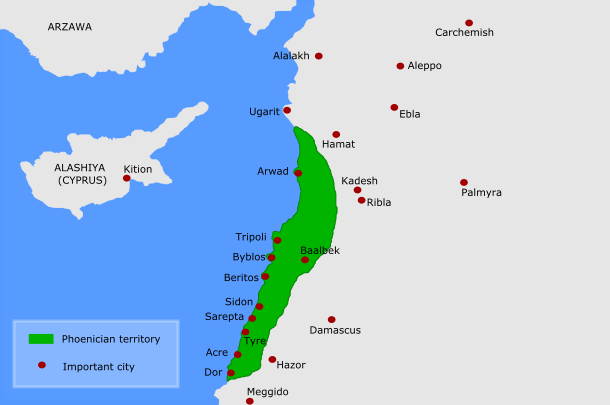
The Phoenician civilization didn't spring fully formed from the sea; it evolved directly from the Canaanite peoples of the Late Bronze Age. As the great Bronze Age empires crumbled around 1200 BCE, the coastal Canaanites, centered in cities like Tyre, Sidon, and Byblos, adapted and thrived. They retained their Semitic language and cultural traditions, but their focus shifted dramatically towards maritime trade. Unlike their land-based predecessors, these Iron Age Phoenicians, as the Greeks would later call them, leveraged their strategic location to become the premier merchants of the ancient world. Their settlements, often fortified city-states, became hubs for the exchange of raw materials like timber, metals, and purple dye, as well as finished goods. This period of expansion saw them establish colonies and trading posts across the Mediterranean, from Cyprus and Crete to North Africa and Iberia, laying the groundwork for future empires like Carthage.
⚙️ How It Works
The 'how' of Phoenician success was a potent combination of maritime innovation and commercial acumen. Their ships, famously depicted in reliefs and mentioned in ancient texts, were advanced for their time, capable of long-distance voyages. They mastered navigation, likely using celestial bodies and coastal landmarks, allowing them to traverse the vast Mediterranean. Their economic engine was built on a sophisticated system of trade, often involving the transport of raw materials like cedarwood from Lebanon, metals from Spain, and agricultural products from Egypt and Anatolia. They developed standardized weights and measures and a flexible system of credit, facilitating complex transactions. Crucially, their invention of a phonetic alphabet, consisting of around 22 consonant symbols, revolutionized communication and record-keeping, making literacy more accessible than the complex cuneiform or hieroglyphic systems.
📊 Key Facts & Numbers
Phoenician influence spanned an astonishing geographical area, with evidence of their presence found in over 300 settlements across the Mediterranean. Their trading network generated immense wealth, with purple dye, extracted from Murex snails and famously associated with royalty, being a particularly lucrative commodity. A single Tyrian purple dye workshop could produce significant quantities of this precious substance, fetching exorbitant prices. By the 8th century BCE, they had established colonies as far west as Gadir (modern Cádiz) in Spain, a testament to their navigational prowess and commercial reach. The Phoenician alphabet, comprising approximately 22 letters, was adopted and adapted by numerous cultures, forming the basis for the Greek alphabet, which in turn influenced the Latin alphabet used by billions today. The sheer volume of Phoenician artifacts, including pottery, glass, and metalwork, unearthed from Sicily to Sardinia, underscores their pervasive economic footprint.
👥 Key People & Organizations
While Phoenicia was a collection of independent city-states rather than a unified kingdom, certain figures and entities stand out. The merchants and sailors themselves, though often anonymous, were the true agents of Phoenician expansion. In the city of Tyre, powerful dynasties often held sway, with figures like King Hiram I (reigned c. 980–947 BCE) playing a crucial role in forging alliances and facilitating trade, notably with King Solomon of Israel for materials and expertise for the Temple in Jerusalem. The city of Carthage, founded by Phoenician colonists from Tyre around 814 BCE, grew into a formidable power in its own right, eventually challenging Rome in the Punic Wars. Its legendary founder, Dido (also known as Elissa), is a pivotal figure in Phoenician colonial history, embodying the spirit of enterprise and resilience. The Phoenician alphabet itself, while not attributable to a single inventor, represents a collective intellectual achievement of their scribes and scholars.
🌍 Cultural Impact & Influence
The cultural impact of the Phoenicians is immeasurable, primarily through their alphabet and their role as cultural intermediaries. The Phoenician alphabet, a simple and efficient phonetic system, was a revolutionary invention that democratized literacy. Its adoption by the Greeks led to the development of the first true alphabet with vowels, which then passed to the Romans and subsequently spread throughout Europe. This linguistic legacy underpins much of Western communication. Beyond the alphabet, Phoenicians facilitated the transmission of technologies, artistic styles, and religious ideas across the Mediterranean. Their purple dye became a symbol of luxury and power across the ancient world, influencing fashion and status. Their shipbuilding techniques and navigational knowledge were adopted and adapted by subsequent maritime powers, from the Greeks and Romans to the Vikings. The very concept of extensive, long-distance maritime trade owes a significant debt to their pioneering efforts.
⚡ Current State & Latest Developments
While the classical Phoenician civilization effectively ceased to exist as a distinct political and cultural entity by the Roman period, its legacy is far from dormant. Modern Lebanon, the heartland of ancient Phoenicia, actively embraces its Phoenician heritage, with archaeological sites like Byblos and Tyre attracting significant tourism and scholarly attention. The ongoing exploration of Phoenician shipwrecks and the decipherment of inscriptions continue to reveal new insights into their society and economy. The enduring influence of the Phoenician alphabet in modern scripts means their linguistic contribution remains a vibrant, active force in global communication. Furthermore, the study of Phoenician trade networks and colonial expansion provides valuable case studies for understanding globalization and cultural diffusion in antiquity, informing contemporary discussions on trade and international relations.
🤔 Controversies & Debates
The primary controversy surrounding Phoenician civilization centers on the very definition of 'Phoenician' itself. The term 'Phoenicia' was a Greek exonym, and the people themselves primarily identified with their individual city-states (Tyre, Sidon, Byblos) or as Canaanites. This has led to debates about whether they constituted a distinct ethnic group or a collection of related Semitic peoples united by maritime commerce and a shared cultural sphere. Another point of contention involves the extent of their influence versus their role as mere conduits for ideas from other cultures, such as Mesopotamia and Egypt. While their alphabet is undeniably a major innovation, some scholars debate the degree to which they were originators versus adapters of existing concepts. The historical narrative of Phoenicia has also been intertwined with later nationalistic claims, particularly in Lebanon, leading to complex interpretations of their identity and legacy.
🔮 Future Outlook & Predictions
The future of understanding Phoenician civilization lies in continued archaeological discovery and advancements in analytical techniques. As new shipwrecks are found and ancient sites are excavated, particularly in the western Mediterranean colonies like Carthage and Gadir, a more detailed picture of their daily lives, economic activities, and social structures will emerge. Genetic studies, analyzing ancient DNA from Phoenician burial sites, could shed further light on their ethnic origins and population movements. The ongoing digital humanities revolution offers new ways to analyze and disseminate Phoenician inscriptions, potentially revealing patterns and connections previously overlooked. Future research will likely focus on the nuanced interactions between Phoenician colonists and indigenous populations, and the long-term impact of their trade routes on the development of diverse regional economies and cultures across the Mediterranean basin.
💡 Practical Applications
The most significant practical application of Phoenician civilization is, without question, the alphabet. This phonetic script, with its relatively small number of symbols representing distinct sounds, revolutionized literacy and record-keeping. It allowed for easier learning and wider dissemination of knowledge compared to earlier syllabic or logographic systems. This innovation directly paved the way for the Greek alphabet, which introduced vowels, and subsequently the Latin alphabet, which forms the basis of most European writing systems. Beyond language, Phoenician shipbuilding and navigation techniques were practical applications that enabled extensive trade and exploration, influencing maritime technology for centuries. Their expertise in producing purple dye also had practical applications in dyeing textiles, creating a highly valued commodity that shaped fashion and signaled status across the ancient world.
Key Facts
- Year
- c. 1500 BCE – 300 BCE
- Origin
- Levant (Eastern Mediterranean coast)
- Category
- history
- Type
- movement
Frequently Asked Questions
Who were the Phoenicians and where did they live?
The Phoenicians were an ancient Semitic people who inhabited the coastal regions of the eastern Mediterranean, primarily in what is now modern Lebanon, from approximately 1500 BCE to 300 BCE. Their civilization was centered around powerful city-states such as Tyre, Sidon, and Byblos, which became renowned for their maritime trade and colonization efforts across the Mediterranean Sea. They emerged directly from the earlier Canaanite culture and were known for their sophisticated seafaring technology and their groundbreaking invention of the phonetic alphabet.
What is the most significant contribution of the Phoenicians?
The most significant and enduring contribution of the Phoenicians is undoubtedly their invention and dissemination of the phonetic alphabet. This system, consisting of around 22 consonant symbols, was a revolutionary simplification of writing compared to earlier complex scripts like cuneiform and hieroglyphs. It was more accessible, facilitating literacy and record-keeping, and was subsequently adopted and adapted by the Greeks, who added vowels, leading to the alphabet used by much of the Western world today. This linguistic innovation profoundly impacted communication, literature, and the spread of knowledge.
How did the Phoenicians influence other ancient civilizations?
Phoenician influence was vast, primarily through their extensive maritime trade networks and colonization. They acted as crucial intermediaries, facilitating the exchange of goods, technologies, and ideas between the Near East, North Africa, and Europe. Their ships and navigational skills opened up new trade routes, bringing raw materials like cedarwood and metals to various regions and distributing manufactured goods and cultural innovations. Their alphabet, as mentioned, was a transformative influence on literacy, and their artistic styles and religious concepts also spread through their interactions with cultures like the Greeks, Etruscans, and Egyptians.
Did the Phoenicians have a unified empire?
No, the Phoenicians did not form a unified empire in the way that, for example, the Romans or Persians did. Instead, their civilization was characterized by a collection of independent, often competing, city-states along the Levantine coast. While these city-states shared a common language, culture, and economic interests, they were politically autonomous. Their power and influence stemmed from their collective maritime and commercial prowess, and the establishment of numerous colonies and trading posts across the Mediterranean, rather than from centralized imperial control.
What happened to the Phoenician civilization?
The classical Phoenician civilization gradually declined and was eventually absorbed by larger empires. As the Persian Empire rose, it exerted control over the Phoenician city-states. Later, the conquests of Alexander the Great in the 4th century BCE and the subsequent Hellenistic period led to the increasing dominance of Greek culture and language in the region. The most powerful Phoenician colony, Carthage, continued to be a major force until its destruction by Rome in the Punic Wars (146 BCE). While Phoenician language and culture persisted in some areas for centuries, particularly in Carthage, they eventually faded into the broader cultural landscape of the Roman and Byzantine empires.
How did Phoenicians make their famous purple dye?
The Phoenicians were masters of producing a highly prized purple dye, known as Tyrian purple, extracted from the mucus of certain species of Murex sea snails. The process was labor-intensive and required thousands of snails to produce even a small amount of dye, making it incredibly expensive and a symbol of royalty and wealth. Snails were harvested, their glands removed, and then subjected to a complex process of decomposition and extraction, often involving sunlight and specific treatments. The resulting dye produced a range of hues from deep violet to reddish-purple, which was highly resistant to fading, further contributing to its value.
What evidence do we have of Phoenician civilization today?
Abundant archaeological evidence testifies to the existence and influence of Phoenician civilization. This includes extensive ruins of their city-states like Tyre, Sidon, and Byblos in Lebanon, as well as their major colony Carthage in Tunisia. Excavations have unearthed vast quantities of Phoenician artifacts, such as pottery, glasswork, metal tools, jewelry, and sarcophagi, many bearing inscriptions in the Phoenician alphabet. Numerous shipwrecks have been discovered, providing invaluable insights into their maritime technology and trade goods. Furthermore, thousands of Phoenician inscriptions, found from Iberia to Mesopotamia, offer direct textual evidence of their language, religion, and commercial activities.