
Contents
- 🎵 Origins & History
- ⚙️ How It Works
- 📊 Key Facts & Numbers
- 👥 Key People & Organizations
- 🌍 Cultural Impact & Influence
- ⚡ Current State & Latest Developments
- 🤔 Controversies & Debates
- 🔮 Future Outlook & Predictions
- 💡 Practical Applications
- 📚 Related Topics & Deeper Reading
- Frequently Asked Questions
- References
- Related Topics
Overview
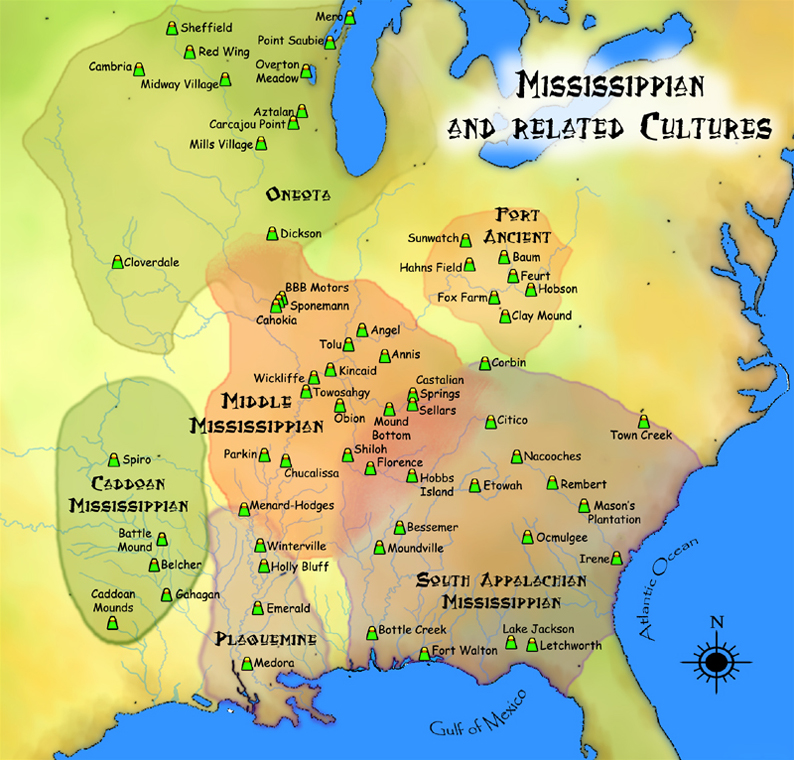
The genesis of the Mississippian culture is generally traced to the Mississippi River Valley and its tributaries, with evidence suggesting a development trajectory beginning around 800 CE. Precursors include the Woodland Period cultures, particularly the Hopewell Interaction Sphere, which established early long-distance trade routes and mound-building traditions, though on a smaller scale. The adoption and intensification of maize agriculture, likely originating from Mesoamerica, provided the caloric surplus necessary for population growth and social stratification. Early Mississippian centers, such as Moundville in Alabama and Cahokia in Illinois, began to emerge and expand significantly between 1000 and 1200 CE. The arrival of European explorers in the 16th century, notably Hernando de Soto's expedition in 1540, marked a period of immense disruption, leading to widespread depopulation due to disease and conflict, though some Mississippian traditions persisted, particularly among the Natchez until the 18th century.
⚙️ How It Works
Mississippian societies were fundamentally agrarian, with maize as their staple crop, supplemented by beans, squash, and local flora and fauna. This agricultural base supported hierarchical social structures, with elites residing atop the large platform mounds, which were constructed through the labor of commoners over generations. These mounds, often arranged around central plazas, served as focal points for ceremonial activities, political gatherings, and elite burials. Craft specialization was evident in the production of finely crafted pottery, shell gorgets, copper ornaments, and stone tools, often exchanged through extensive trade networks that spanned hundreds of miles, connecting regions from the Great Lakes to the Gulf Coast. Political organization varied, ranging from chiefdoms to more complex paramount chiefdoms, with Cahokia representing the apex of this complexity.
📊 Key Facts & Numbers
The Mississippian culture spanned approximately 800 years and covered a vast geographical area, encompassing at least 30 modern-day U.S. states. At its zenith, Cahokia may have housed between 10,000 and 20,000 inhabitants, making it larger than contemporary London. Over 100 mounds have been identified at the Cahokia site alone, with Monks Mound, the largest, covering over 14 acres and standing nearly 100 feet tall. Archaeological evidence suggests that by 1300 CE, many major Mississippian centers had declined or were abandoned, a phenomenon often attributed to environmental degradation, resource depletion, and social upheaval. The Cherokee and Muscogee (Creek) nations are among the descendant groups whose ancestral territories overlapped with Mississippian sites.
👥 Key People & Organizations
While no single individual 'founded' the Mississippian culture, key figures in its study include archaeologists like Cyril C. Thomson, who conducted extensive work at Moundville, and Robert L. Hall, a prominent researcher of Cahokia. The Smithsonian Institution and various university archaeological departments, such as the University of Illinois and the University of Alabama, have been instrumental in excavating and interpreting Mississippian sites. Indigenous nations such as the Missouria, Osage, Quapaw, Caddo, and Choctaw are considered descendants of Mississippian peoples, maintaining cultural and historical connections to these ancient sites. The National Park Service manages several significant Mississippian sites, including Ocmulgee Mounds National Historical Park in Georgia.
🌍 Cultural Impact & Influence
The Mississippian culture left an indelible mark on the North American landscape and its subsequent history. The monumental earthworks, such as those at Cahokia and Moundville, stand as testaments to sophisticated engineering and social organization, influencing later perceptions of Indigenous capabilities. Their agricultural innovations, particularly maize cultivation, fundamentally altered subsistence patterns across the Eastern Woodlands. The extensive trade networks facilitated the exchange of not only goods but also ideas and technologies, contributing to cultural diffusion. The legacy of Mississippian societies is preserved in the oral traditions and cultural practices of many contemporary Native American tribes, who continue to hold these sites as sacred ancestral lands.
⚡ Current State & Latest Developments
In the present day, the study of Mississippian culture continues through ongoing archaeological research, employing advanced techniques like LiDAR scanning and DNA analysis to uncover new insights. Sites like Cahokia Mounds State Historic Site and Chucalissa Archaeological Museum serve as vital centers for public education and preservation. Debates persist regarding the precise causes of the widespread societal collapse around 1300 CE, with new research continually refining our understanding of environmental, social, and political factors. The recognition of Ocmulgee Mounds as a potential National Park highlights a growing movement to elevate the status and protection of these critical historical sites. Efforts are also underway to better integrate Indigenous perspectives into archaeological interpretations, fostering a more collaborative approach to understanding this complex past.
🤔 Controversies & Debates
A significant debate surrounds the interpretation of Mississippian mound construction and societal collapse. While traditional narratives often focused on environmental determinism or external invasions, contemporary scholarship increasingly emphasizes the agency of Mississippian peoples and the complex interplay of social, political, and environmental factors. The degree of centralized authority in polities like Cahokia is also a subject of ongoing discussion, with some scholars arguing for a more decentralized or fluid system than previously assumed. Furthermore, the precise nature of the interactions between Mississippian societies and the earliest European explorers, particularly concerning the transmission of diseases like smallpox that decimated populations, remains a critical area of research and contention.
🔮 Future Outlook & Predictions
The future of Mississippian studies will likely involve continued refinement of dating techniques and a greater emphasis on interdisciplinary approaches, integrating archaeology with ethnohistory, genetics, and paleoenvironmental science. The potential designation of Ocmulgee Mounds as a National Park could set a precedent for increased federal protection and recognition of other major Mississippian sites. Advances in remote sensing technologies will undoubtedly reveal previously unknown settlements and landscape modifications. Furthermore, the growing involvement of descendant Indigenous communities in research and interpretation promises to enrich our understanding, moving beyond colonial-era biases and toward a more holistic and respectful engagement with this ancient heritage.
💡 Practical Applications
The primary 'application' of studying Mississippian culture lies in understanding the deep history of human settlement and societal development in North America. Archaeological sites like Cahokia Mounds and Moundville serve as invaluable educational resources, attracting hundreds of thousands of visitors annually and fostering public awareness of pre-Columbian achievements. The insights gained into ancient agricultural practices, urban planning, and resource management can offer lessons for contemporary sustainability efforts. Moreover, the study of Mississippian social structures and political organization provides comparative data for anthropologists and historians examining the evolution of complex societies worldwide. The preservation and interpretation of these sites also contribute to cultural tourism and economic development in the surrounding regions.
Key Facts
- Year
- c. 800 – 1600 CE
- Origin
- Midwestern, Eastern, and Southeastern United States
- Category
- history
- Type
- concept
Frequently Asked Questions
What were the most distinctive features of the Mississippian culture?
The Mississippian culture is most famously recognized for its monumental earthwork construction, particularly large, rectangular platform mounds that served as foundations for elite structures and ceremonial spaces. These societies also developed sophisticated maize-based agriculture, which supported dense populations and enabled the growth of complex, hierarchical societies. Extensive trade networks facilitated the exchange of goods like shell, copper, and mica across vast distances, and they often organized into large settlements or urban centers, with Cahokia being the most prominent example.
Where was the Mississippian culture located, and when did it exist?
The Mississippian culture flourished across a wide area of what is now the Midwestern, Eastern, and Southeastern United States, roughly from the Mississippi River Valley eastward to the Appalachian Mountains and from the Great Lakes region southward to the Gulf Coast. Its existence is generally dated from approximately 800 CE to 1600 CE, though regional variations and the persistence of certain traditions, like those of the Natchez, extended beyond this timeframe into the 18th century.
What led to the decline of the Mississippian culture?
The decline of major Mississippian centers around 1300 CE is a complex issue with no single definitive cause. Leading theories suggest a combination of factors, including environmental degradation from intensive agriculture, resource depletion, internal social and political strife, and possibly the impact of diseases introduced by early European explorers, though the latter primarily affected later periods. The widespread abandonment of large sites points to a significant societal reorganization rather than a complete disappearance of the people themselves, with many descendant groups continuing to inhabit the region.
What is the significance of Cahokia in Mississippian culture?
Cahokia, located near modern-day St. Louis in Illinois, was the largest and most influential center of the Mississippian culture. At its peak, it may have housed 10,000 to 20,000 people, featuring massive earthen structures like Monks Mound, the largest prehistoric earthwork in the Americas. Cahokia served as a major political, religious, and economic hub, demonstrating the peak of Mississippian social complexity and urbanism. Its eventual decline and abandonment remain a critical focus for understanding Mississippian societal dynamics.
Are there any direct descendants of the Mississippian people today?
Yes, many contemporary Native American tribes are considered descendants of the Mississippian peoples, as they occupied territories that overlapped with Mississippian settlements. These include groups such as the Cherokee, Muscogee (Creek), Choctaw, Chickasaw, Quapaw, Osage, and Caddo nations, among others. These nations often maintain cultural traditions, historical connections, and ancestral claims to the archaeological sites left by their Mississippian forebears.
How can I visit or learn more about Mississippian sites?
Numerous significant Mississippian sites are preserved and accessible to the public. Key locations include Cahokia Mounds State Historic Site in Illinois, Moundville Archaeological Park in Alabama, Etowah Indian Mounds Historic Site in Georgia, and Ocmulgee Mounds National Historical Park in Georgia. Many of these sites feature interpretive centers, museums, and reconstructed elements, offering immersive educational experiences about Mississippian life and achievements.
What impact did European contact have on the Mississippian culture?
The arrival of Europeans, notably Hernando de Soto's expedition in the mid-16th century, had a catastrophic impact on Mississippian societies. While direct conflict occurred, the most devastating effect was the introduction of Old World diseases, such as smallpox, measles, and influenza, to which Indigenous populations had no immunity. These epidemics swept through the continent, causing massive depopulation, social disruption, and the collapse of many complex Mississippian polities, fundamentally altering the trajectory of Indigenous North America.