
Contents
Overview
Military alliances are formal agreements between sovereign states, pledging mutual support, most commonly in matters of national defense. These pacts can range from defensive commitments, where an attack on one member triggers a collective response, to broader security arrangements. Historically, alliances have been a double-edged sword: while often formed to deter aggression and maintain a balance of power, they have also been instrumental in escalating regional disputes into global conflagrations. The post-World War II era has seen a shift towards more public, often institutionalized alliances like NATO, which emphasize collective defense and deterrence, though the underlying strategic calculus of balancing power and managing threats remains constant. The sheer volume of historical treaties underscores their persistent role in international relations, with ongoing debates about their effectiveness in preventing war versus their potential to entangle nations in unwanted conflicts.
🎵 Origins & History
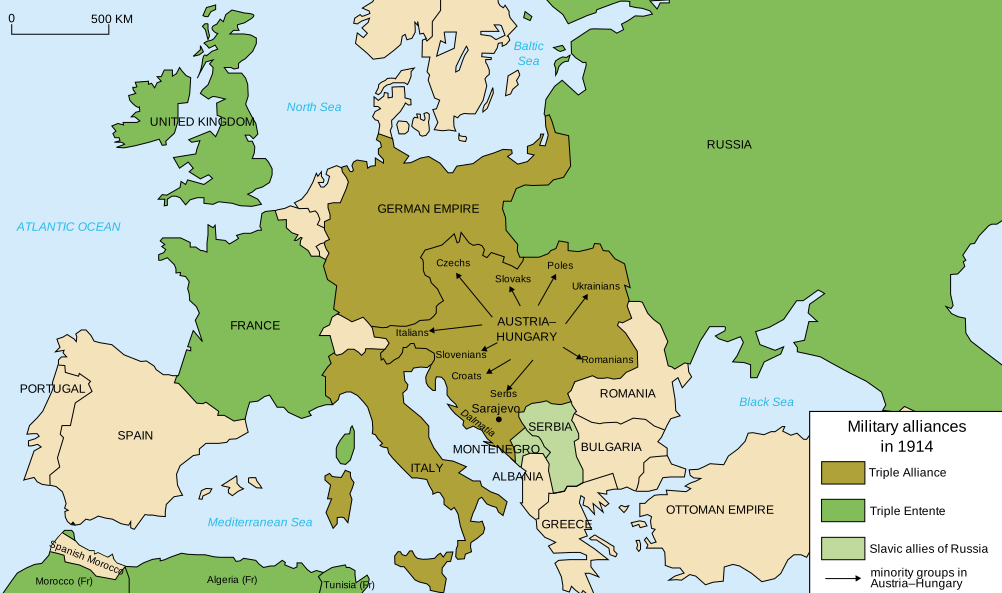
The concept of military alliances is as old as organized warfare itself, with early examples found in ancient Greece. The medieval period saw feudal lords forming alliances, and the Renaissance brought more formalized treaties between nascent nation-states. A significant precursor to modern alliances was the Holy Alliance, established by Tsar Alexander I of Russia, Francis I of Austria, and Frederick William III of Prussia, aiming to uphold Christian principles and suppress revolutionary movements. The late 19th and early 20th centuries witnessed the rise of complex, often secret, alliance systems, like the Triple Alliance (Germany, Austria-Hungary, Italy) and the Triple Entente (France, Russia, Great Britain), which ultimately contributed to the outbreak of World War I in 1914.
⚙️ How It Works
At their core, military alliances function through formal treaties that codify mutual security obligations. These agreements typically outline specific triggers for collective action, such as an unprovoked attack on a member state. The most common type is a defensive alliance, where signatories pledge to defend each other. Other forms include non-aggression pacts, which forbid attacking one another, and ententes, which represent a less binding understanding or alignment of interests. The operationalization of an alliance often involves joint military exercises, standardization of equipment and doctrine, intelligence sharing, and sometimes the stationing of troops on allied territory. The effectiveness of an alliance hinges on the credibility of its commitments, the perceived strength of its combined military forces, and the willingness of members to bear the costs of collective security, as demonstrated by the mutual defense clauses within NATO's Article 5.
📊 Key Facts & Numbers
The vast majority of alliance commitments involve explicit pledges of military support in times of war. Defensive alliances constitute the largest segment, with studies suggesting they have a deterrent effect, potentially reducing the likelihood of interstate conflict by an estimated 10-20%. However, the entangling nature of alliances has also been a significant factor in conflict escalation; the July Crisis of 1914, triggered by the assassination of Archduke Franz Ferdinand, rapidly drew in over 30 nations due to pre-existing treaty obligations. Post-WWII alliances, such as NATO and the Warsaw Pact, involved hundreds of thousands of active personnel and trillions of dollars in combined defense spending during their peak.
👥 Key People & Organizations
Key figures and organizations have shaped the trajectory of military alliances. Otto von Bismarck, as Chancellor of Germany, masterfully employed a complex web of alliances in the late 19th century to isolate France and maintain European peace, though his system proved fragile after his departure. Franklin D. Roosevelt was instrumental in forging the Allied coalition during World War II, laying the groundwork for post-war security structures. The North Atlantic Treaty Organization (NATO), established in 1949, remains the most prominent modern military alliance, with its founding members including the United States, United Kingdom, and France. Its counterpart during the Cold War was the Warsaw Pact, led by the Soviet Union. More recently, regional alliances like the ASEAN Defence Ministers' Meeting Plus (ADMM-Plus) and bilateral agreements, such as the ANZUS Treaty between Australia, New Zealand, and the United States, continue to define security architectures.
🌍 Cultural Impact & Influence
Military alliances have profoundly influenced global culture, shaping perceptions of security, threat, and national identity. The very existence of blocs like NATO and the Warsaw Pact created a bipolar world order during the Cold War, fostering a pervasive sense of ideological struggle and mutual suspicion that permeated art, literature, and film. The concept of 'collective security' became a cornerstone of international relations discourse, influencing diplomatic practices and the formation of international bodies like the United Nations. Alliances have also inspired numerous fictional narratives, from spy thrillers to grand strategy video games like Hearts of Iron IV, where players manage intricate diplomatic and military pacts. The cultural resonance of these alliances is evident in national anthems, military parades, and the enduring public discourse surrounding defense commitments and international cooperation.
⚡ Current State & Latest Developments
In the current geopolitical climate of 2024-2025, military alliances are experiencing a resurgence and redefinition. NATO has seen renewed purpose and expansion, notably with the accession of Finland in 2023 and Sweden in 2024, driven by increased Russian assertiveness following the 2022 invasion of Ukraine. The Quadrilateral Security Dialogue (Quad), comprising the United States, Japan, Australia, and India, is increasingly functioning as a de facto security alliance focused on the Indo-Pacific region, though its members are cautious about formalizing it. China and Russia have strengthened their strategic partnership, engaging in joint military exercises and deepening economic ties, signaling a potential counter-bloc. Emerging security arrangements, such as those in the Middle East involving Israel, the UAE, and the US, indicate a shifting landscape of regional security cooperation.
🤔 Controversies & Debates
The efficacy and morality of military alliances remain subjects of intense debate. A central controversy is whether alliances primarily deter war or inadvertently provoke it by creating security dilemmas and entangling states in conflicts they might otherwise avoid. Critics, like John Mearsheimer, argue that alliances often lead to overextension and entanglement, citing the Vietnam War as a prime example of a commitment spiraling out of control. Conversely, proponents highlight the stability provided by alliances like NATO, which is credited by many with maintaining peace in Europe for over seven decades. Another point of contention is the democratic versus autocratic nature of alliances; while democratic states often form alliances based on shared values, as seen in the Five Eyes intelligence-sharing network, autocratic regimes also form strategic pacts, raising concerns about collective repression or aggression. The debate over burden-sharing within alliances, particularly the perceived imbalance between US contributions and those of European allies, is a persistent point of friction.
🔮 Future Outlook & Predictions
Looking ahead, military alliances are likely to become more fluid and issue-specific, adapting to evolving threats. The rise of cyber warfare and artificial intelligence may necessitate new forms of alliance, focusing on shared technological capabilities and rapid response mechanisms. We could see the formalization of 'minilateral' security arrangements, where smaller groups of like-minded states collaborate on specific regional challenges, potentially bypassing larger, more unwieldy organizations. The ongoing strategic competition between the US and China will likely drive further alignment and counter-alignment, potentially leading to new security architectures in the Indo-Pacific and beyond. Expert forecasts suggest that while traditional alliances like NATO will endure, their focus may shift towards hybrid threat
Key Facts
- Category
- history
- Type
- topic