Contents
- 🎵 Origins & Definition
- ⚙️ Geographic & Political Landscape
- 📊 Key Demographics & Economics
- 👥 Major Nations & Their Characteristics
- 🌍 Cultural & Religious Significance
- ⚡ Geopolitical Dynamics & Conflicts
- 🤔 Defining the Boundaries: A Contested Space
- 🔮 Future Trajectories & Emerging Trends
- 💡 Regional Interconnections & Global Impact
- 📚 Further Exploration & Related Regions
- References
Overview
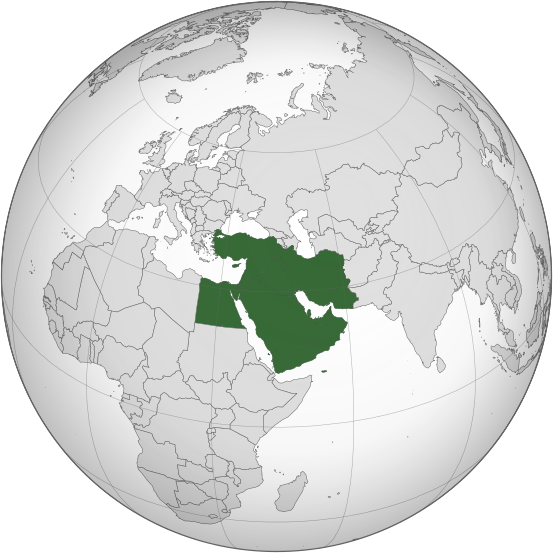
The Middle East is a vast and complex geopolitical region, a crossroads of continents and civilizations, encompassing a diverse array of countries with rich histories, varied cultures, and significant global influence. Geographically, it's often defined as encompassing Egypt and Western Asia, excluding the Caucasus, though its precise boundaries are subject to ongoing debate and redefinition. This region, historically known as the Near East, is a cradle of major religions like Judaism, Christianity, and Islam, and has been a stage for empires, conflicts, and cultural exchange for millennia. Today, its nations are characterized by a blend of ancient traditions and rapid modernization, with economies ranging from oil-rich states to those striving for diversification. The region's strategic importance, particularly concerning energy resources and trade routes, ensures its continued prominence in international affairs, making its internal dynamics and external relations a subject of constant global scrutiny.
🎵 Origins & Definition
The term "Middle East" itself is a relatively recent construct, largely popularized in the early 20th century by Western strategists and geographers seeking to delineate a region of strategic importance between Europe and the Far East. Unlike strictly continental definitions, its boundaries are fluid, often incorporating parts of Southeast Europe like East Thrace due to its inclusion in Turkey, while sometimes excluding areas like the Caucasus. Historically, this region was known as the "Near East," a designation that shifted as geopolitical perspectives evolved. The very definition of the Middle East is a subject of ongoing discussion, with different organizations and scholars proposing varying country lists, often leading to confusion and disagreement. This ambiguity highlights the region's complex historical and political identity, shaped by millennia of migrations, conquests, and cultural diffusion.
⚙️ Geographic & Political Landscape
Geographically, the Middle East is a land bridge connecting Africa, Asia, and Europe, characterized by diverse terrains ranging from vast deserts like the Arabian Desert to fertile river valleys such as the Nile and the Tigris-Euphrates. Politically, it is a mosaic of sovereign states, each with distinct governance structures, from monarchies like Saudi Arabia and Jordan to republics like Egypt and Iraq. The region is home to significant oil reserves, particularly in the Persian Gulf states, which have profoundly shaped its economic development and international relations. The presence of major international shipping routes, such as the Suez Canal, further amplifies its strategic significance.
📊 Key Demographics & Economics
The Middle East is home to over 400 million people, representing a rich tapestry of ethnicities, languages, and traditions. Arabic is the predominant language across much of the region, though Persian, Hebrew, Kurdish, and Turkish are also widely spoken. The region boasts a young demographic profile in many countries, with a significant proportion of the population under the age of 25. Economically, the Middle East presents a stark contrast, with oil-exporting nations like UAE and Qatar enjoying high per capita incomes, while others, such as Yemen and Syria, grapple with poverty and conflict. Diversification efforts are underway in many economies, driven by initiatives like Saudi Vision 2030 and Dubai's economic diversification strategies.
👥 Major Nations & Their Characteristics
Key nations within the Middle East include Egypt, the most populous Arab country; Saudi Arabia, a major oil producer; Iran, with its distinct Persian culture and Shia Islamic Republic; Turkey, a transcontinental country bridging Europe and Asia; Iraq, historically known as Mesopotamia; Israel, a nation with deep religious significance; and the GCC states like UAE, Qatar, and Kuwait, known for their oil wealth and modern infrastructure. Each country possesses unique political systems, historical narratives, and cultural expressions, contributing to the region's overall complexity. The interplay between these nations, their alliances, and rivalries forms the core of Middle Eastern geopolitics.
🌍 Cultural & Religious Significance
The Middle East is the birthplace of three major monotheistic religions: Judaism, Christianity, and Islam. Jerusalem, Mecca, and Medina are among the holiest cities in the world, drawing millions of pilgrims annually. This religious significance has profoundly shaped the region's cultural landscape, influencing art, architecture, literature, and social customs for centuries. Beyond religion, the region is renowned for its rich artistic heritage, including classical Arabic poetry, intricate Islamic architecture, and vibrant traditional music. The culinary traditions, from Middle Eastern cuisine like hummus and kebabs to Persian stews, are celebrated globally.
⚡ Geopolitical Dynamics & Conflicts
The geopolitical landscape of the Middle East is marked by a history of conflict, shifting alliances, and external interventions. Major ongoing issues include the Israeli–Palestinian conflict, the Syrian Civil War, and the complex regional rivalry between Iran and Saudi Arabia. The presence of significant oil and gas reserves has historically attracted the attention of global powers, leading to complex international relations and interventions. The rise of non-state actors and the impact of Arab Spring uprisings in the early 2010s have further destabilized the region, creating ongoing challenges for peace and security. The role of international organizations like the United Nations and regional bodies like the Arab League in mediating disputes remains crucial.
🤔 Defining the Boundaries: A Contested Space
The definition of the Middle East is a persistent point of contention. Some definitions include North African countries like Morocco and Algeria, forming the "Middle East and North Africa" (MENA) region, while others extend it to include parts of Central Asia. The term "Greater Middle East" has also been used, often in a political context, to encompass a wider array of Muslim-majority nations. This definitional ambiguity stems from the region's historical fluidity and the varying political and cultural lenses through which it is viewed. The inclusion or exclusion of countries like Cyprus or Armenia further complicates the geographical consensus, highlighting the subjective nature of regional labels.
🔮 Future Trajectories & Emerging Trends
The future of the Middle East is likely to be shaped by several key trends. Economic diversification away from oil dependence is a major focus for many nations, with significant investments in technology, tourism, and renewable energy. The demographic bulge of young populations presents both an opportunity for growth and a challenge for employment and social stability. Climate change, particularly water scarcity and rising temperatures, poses a significant long-term threat. Furthermore, the ongoing efforts towards regional normalization, exemplified by the Abraham Accords, suggest a potential shift in geopolitical alignments, though deep-seated conflicts and rivalries will continue to pose challenges to lasting peace and stability. The role of artificial intelligence and digital transformation in reshaping economies and societies is also a growing factor.
💡 Regional Interconnections & Global Impact
The Middle East serves as a critical nexus for global trade, energy, and culture. Its strategic location facilitates vital global trade routes, and its vast energy resources are indispensable to the world economy. Culturally, the region has exported its rich heritage through music, cuisine, and art, influencing global trends. The ongoing geopolitical developments within the Middle East have ripple effects worldwide, impacting international relations, security, and economic stability. The region's interconnectedness with Europe, Asia, and Africa makes its internal dynamics a matter of global concern, influencing everything from energy prices to international diplomacy.
Key Facts
- Category
- culture
- Type
- topic