
Contents
Overview
The recorded history of the Korean Peninsula stretches back to antiquity. The peninsula later coalesced into the Three Kingdoms period (Goguryeo, Baekje, and Silla). Silla, aided by the Tang Dynasty of China, unified much of the peninsula. This ushered in a period of relative peace and cultural flourishing under the Goryeo Dynasty and later the Joseon Dynasty. The Joseon era saw the creation of the Korean alphabet, Hangul, by King Sejong the Great, a monumental achievement in linguistic accessibility. The late 19th and early 20th centuries brought foreign intervention, culminating in Japanese annexation in 1910, a period of colonial rule that lasted until Japan's defeat in World War II in 1945. The subsequent division by the United States and the Soviet Union along the 38th parallel set the stage for the Korean War and the enduring separation of North and South Korea.
⚙️ Geographical Features
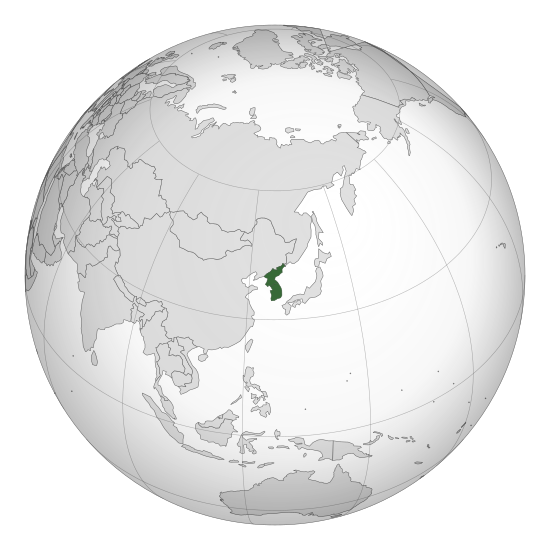
Geographically, the Korean Peninsula is characterized by a mountainous interior and extensive coastlines. The Taebaek Mountains form a significant spine running along the eastern coast. The highest peak is Mount Paektu, an active volcano on the border with China, revered as a spiritual birthplace of the Korean nation. The western and southern coasts feature extensive plains and numerous islands, including Jeju Island, a UNESCO World Heritage site known for its unique volcanic landscape. Major rivers like the Yalu River (Amnok) and the Tumen River form part of the northern border with China and Russia, while the Nakdong and Han rivers are vital waterways for South Korea. The peninsula's climate ranges from temperate in the south to continental in the north, with distinct four seasons.
📊 Key Facts & Numbers
The Korean Peninsula spans an area of approximately 85,270 square kilometers (32,920 square miles). South Korea, occupying the southern two-thirds, is home to an estimated 51.7 million people as of 2023, with a GDP of over $1.7 trillion USD in 2022. North Korea, covering the northern third, has an estimated population of 26.1 million and a GDP of roughly $30 billion USD, making it one of the world's most isolated economies. The Demilitarized Zone (DMZ), a 250-kilometer (160-mile) long buffer zone established by the Korean War Armistice Agreement in 1953, remains one of the most heavily fortified borders globally, with an estimated 1 million soldiers stationed along its perimeter. Over 75 million Koreans live on the peninsula, with significant diaspora communities in China (over 2.5 million), the United States (over 2 million), and Japan (over 600,000).
👥 Key People & Organizations
Key figures shaping the Korean Peninsula's history include King Sejong the Great, credited with the invention of Hangul; Kim Il Sung, the founder of North Korea and its eternal president; and Syngman Rhee, the first president of South Korea. Modern South Korea's economic miracle is often attributed to leaders like Park Chung-hee, who initiated ambitious industrialization policies, and the visionary founders of conglomerates like Samsung and Hyundai. In North Korea, the Kim dynasty—Kim Il Sung, Kim Jong Il, and Kim Jong Un—has maintained absolute control since 1948. International organizations like the United Nations have played a significant role in post-war reconstruction and ongoing security efforts, while entities like the Korean Broadcasting System (KBS) and Korean Central News Agency (KCNA) serve as major media outlets for the South and North, respectively.
🌍 Cultural Impact & Influence
The cultural influence of the Korean Peninsula, particularly South Korea, has exploded globally in recent decades, a phenomenon often termed the 'Korean Wave' or 'K-Wave'. This includes the worldwide popularity of K-pop music, exemplified by groups like BTS and BLACKPINK, whose global reach rivals that of any Western artist. South Korean cinema, with films like Bong Joon-ho's Parasite winning the Academy Award for Best Picture in 2020, has garnered critical acclaim. K-dramas have become a staple on streaming platforms like Netflix, captivating audiences with diverse genres. Traditional Korean culture, including kimchi, hanbok attire, and Taekwondo, also continues to resonate internationally. North Korean culture, while largely inaccessible to the outside world, is characterized by state-controlled propaganda, mass games like the Arirang Mass Games, and a distinct socialist realist artistic style.
⚡ Current State & Latest Developments
As of 2024, the Korean Peninsula remains a region of significant geopolitical tension. North Korea continues its nuclear weapons and ballistic missile programs, leading to ongoing international sanctions and diplomatic stalemates, with recent missile tests occurring in late 2023 and early 2024. South Korea, meanwhile, is experiencing a vibrant economic and cultural boom, solidifying its position as a global technological and entertainment powerhouse, with its semiconductor industry, led by companies like Samsung Electronics and SK Hynix, remaining at the forefront of innovation. Inter-Korean relations fluctuate between periods of cautious dialogue and heightened military posturing, with occasional high-level summits like the 2018 inter-Korean summit offering brief windows of hope for reconciliation. The ongoing presence of US Forces Korea underscores the strategic importance of the peninsula in East Asian security architecture.
🤔 Controversies & Debates
The division of the Korean Peninsula is one of the most enduring legacies of the Cold War and remains a potent source of international debate. Key controversies include North Korea's human rights record, its pursuit of nuclear weapons in defiance of UN Security Council resolutions, and the economic disparity between the North and South. The role of external powers, particularly the United States, China, and Japan, in regional stability and potential reunification is also a subject of intense discussion. Debates persist regarding the effectiveness of sanctions against North Korea, the feasibility of denuclearization, and the long-term implications of the peninsula's division for global security and human rights. The very definition of 'Korean identity' in the face of such profound political and social divergence is also a recurring point of contention.
🔮 Future Outlook & Predictions
The future of the Korean Peninsula is highly uncertain, with several potential trajectories. Reunification, while a long-held aspiration for many Koreans, faces immense practical and political hurdles, including the vast economic gap and differing political ideologies. Continued division, potentially with periods of thawing relations and renewed tensions, remains the most probable short-to-medium term scenario. Some futurists predict a gradual convergence, perhaps driven by economic interdependence or a significant shift in North Korea's political leadership. Others foresee a more volatile future, marked by escalating military provocations or a sudden collapse of the North Korean regime, which would trigger complex international responses. The role of emerging technologies, such as AI and advanced cyber warfare, could also significantly reshape the security landscape and inter-Korean dynamics.
💡 Practical Applications
The Korean Peninsula serves as a critical geopolitical focal point, influencing global security strategies and international relations. Its division cre
Key Facts
- Category
- geography
- Type
- topic