
Contents
Overview
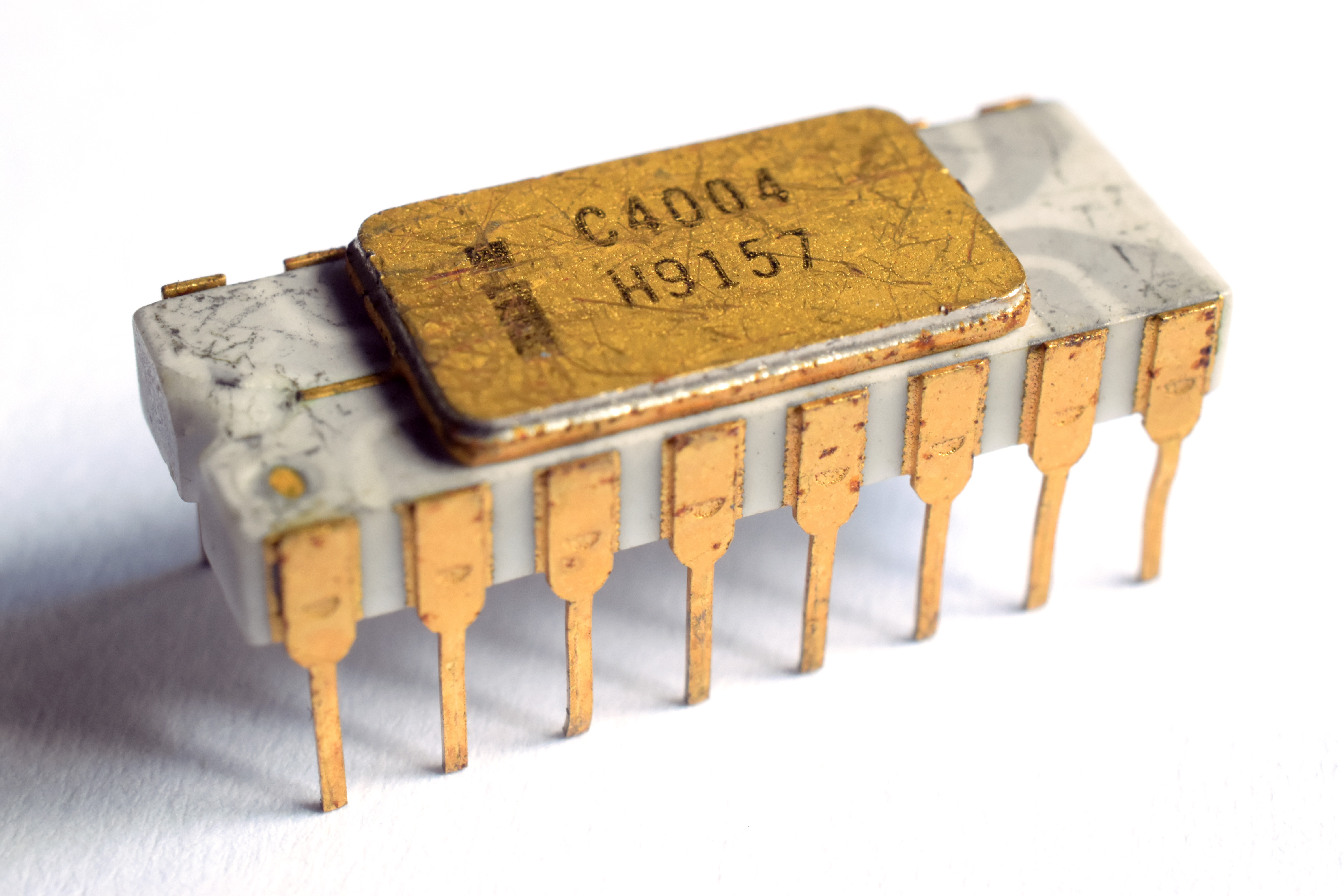
The Intel 4004 project originated in 1969 when Busicom Corp. commissioned Intel to design a family of seven chips for electronic calculators, including a three-chip CPU. Busicom initially envisioned a complex system with multiple chips, but Intel's team, led by Ted Hoff and Stanley Mazor, proposed a more innovative approach: a single-chip CPU. This design, known as the MCS-4 chipset, would serve as a model for future single-chip CPUs, influencing the development of microprocessors at companies like AMD, IBM, and Apple. The 4004 chip was priced at US$60, equivalent to $477 in 2025, making it an attractive option for manufacturers like Hewlett-Packard, who would later develop their own microprocessors.
📈 Technical Specifications
The 4004 CPU was a 4-bit processor, using the MOS silicon gate technology (SGT) to integrate the CPU into a single chip. This technology, developed by Intel's team, enabled twice the transistor density and five times the operating speed of existing technology, making future single-chip CPUs feasible. The MCS-4 chipset design, of which the 4004 was a part, served as a model for how to use SGT for complex logic and memory circuits, accelerating the adoption of SGT by the world's semiconductor industry, including companies like Samsung, Toshiba, and STMicroelectronics. The 4004 chip's technical specifications, including its clock speed and instruction set, would later influence the design of microprocessors like the Intel 8008 and the Zilog Z80.
💻 Impact on Computing
The Intel 4004 had a significant impact on the development of computing, marking the beginning of the microprocessor era. The 4004 chip was used in a variety of applications, including electronic calculators, cash registers, and traffic light controllers, developed by companies like NCR, Olivetti, and Siemens. The success of the 4004 chip led to the development of more powerful microprocessors, such as the Intel 8008 and the Intel 8080, which would go on to power the first personal computers, including the Altair 8800 and the Apple I, designed by pioneers like Steve Wozniak and Steve Jobs. The 4004 chip's influence can also be seen in the development of modern microprocessors, such as those designed by ARM, Qualcomm, and NVIDIA.
🔮 Legacy & Future
The Intel 4004 legacy extends beyond its technical specifications and impact on computing. The 4004 chip marked the beginning of a new era in computing, one that would be characterized by rapid innovation and advancement. The development of the 4004 chip also led to the creation of new industries and job opportunities, as companies like Microsoft, Google, and Facebook would later emerge to capitalize on the growing demand for microprocessors and computing technology. Today, the Intel 4004 is recognized as a pioneering achievement in the history of computing, with its influence still felt in the design of modern microprocessors, such as those used in smartphones, laptops, and servers, developed by companies like Intel, AMD, and IBM.
Key Facts
- Year
- 1971
- Origin
- United States
- Category
- technology
- Type
- technology
Frequently Asked Questions
What was the Intel 4004?
The Intel 4004 was the first commercially available microprocessor, released by Intel Corporation in 1971.
What was the significance of the Intel 4004?
The Intel 4004 marked the beginning of the microprocessor era and had a significant impact on the development of computing.
Who designed the Intel 4004?
The Intel 4004 was designed by Ted Hoff and Stanley Mazor, two engineers at Intel Corporation.
What was the clock speed of the Intel 4004?
The clock speed of the Intel 4004 was 740 kHz.
What was the instruction set of the Intel 4004?
The instruction set of the Intel 4004 consisted of 78 instructions, including arithmetic, logical, and control instructions.