
Contents
Overview
Canada boasts a decentralized higher education system, primarily managed by provincial and territorial governments, alongside federal contributions to research and Indigenous post-secondary initiatives. This structure encompasses universities, colleges, and polytechnics, collectively serving over 1.5 million students annually. Renowned for its quality and accessibility, Canada consistently ranks among the world's most educated nations, with over 56% of adults holding a tertiary degree, a figure that leads the OECD. The system aims to foster a skilled workforce, drive innovation, and ensure national prosperity, though debates persist regarding funding models, accessibility for marginalized groups, and the alignment of curricula with evolving labor market demands. Federal funding, particularly through research granting councils like the NSERC, plays a crucial role in advancing scientific discovery and technological development.
🎵 Origins & History
The roots of Canadian higher education trace back to the colonial era. Following Confederation in 1867, the responsibility for education, including post-secondary, largely fell to the provinces under Section 93 of the Constitution Act, 1867. This decentralization led to the development of distinct provincial systems, each with its own governing bodies and institutions. The mid-20th century saw significant expansion, driven by post-war demographic shifts and a growing recognition of the importance of a skilled workforce, leading to the establishment of numerous new universities and colleges across the country. The Canada Council for the Arts was established in 1957 to support cultural and intellectual pursuits.
⚙️ How It Works
Canada's higher education landscape is characterized by its provincial governance, with each province and territory establishing its own ministries and regulatory frameworks. Universities typically grant degrees, while colleges and polytechnics offer diplomas, certificates, and apprenticeships. Federal involvement is primarily channeled through research funding agencies such as the SSHRC and the CIHR, which support academic research and graduate studies. Indigenous post-secondary education is increasingly recognized, with dedicated institutions and programs designed to serve First Nations, Métis, and Inuit learners, often incorporating traditional knowledge and cultural practices. The Ontario Ministry of Colleges and Universities is an example of a provincial body overseeing a vast network of institutions.
📊 Key Facts & Numbers
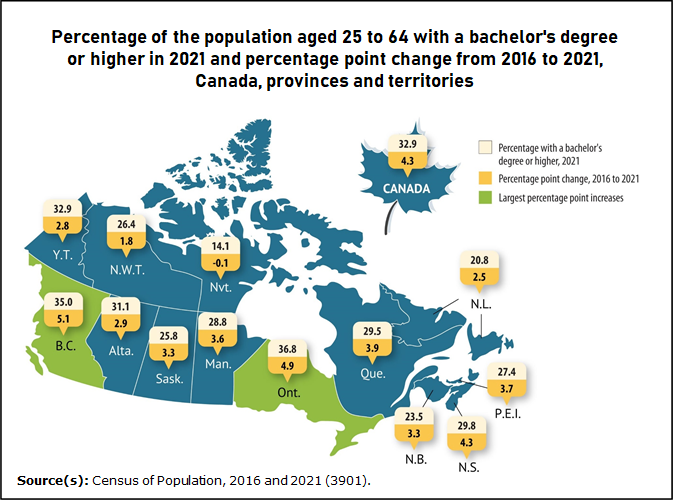
Canada is a global leader in educational attainment. In 2022, over 56% of Canadian adults aged 25-64 held a tertiary qualification, reportedly the highest rate among OECD countries. The country hosts over 1.5 million post-secondary students annually, with international students comprising a significant portion, contributing an estimated $22 billion to the Canadian economy in 2018. There are over 200 degree-granting institutions and more than 150 public colleges and polytechnics. Tuition fees vary widely, averaging around $6,500 CAD for domestic undergraduates in 2023-2024, but can exceed $30,000 CAD for international students, with some professional programs like medicine or dentistry costing significantly more.
👥 Key People & Organizations
Key figures in Canadian higher education include former Prime Minister Pierre Elliott Trudeau, whose government significantly expanded federal funding for universities and research in the 1960s and 70s, and Vincent Massey, the first Canadian-born Governor General, who chaired the Massey Commission in the early 1950s, leading to the establishment of the Canada Council for the Arts and the Tri-Council Funding Agencies. Organizations like Universities Canada and Colleges and Institutes Canada (CI Can) advocate for their member institutions. Prominent universities such as the University of Toronto, University of British Columbia, and McGill University are consistently ranked among the world's top institutions, attracting global talent.
🌍 Cultural Impact & Influence
The high level of educational attainment in Canada directly correlates with its strong performance in innovation and research. Canadian universities are hubs for groundbreaking discoveries, from the development of insulin by Frederick Banting and Charles Best at the University of Toronto to advancements in artificial intelligence by researchers at Mila and the Vector Institute. This educated populace fuels industries ranging from technology and natural resources to healthcare and the arts, contributing to Canada's reputation as a knowledge-based economy. The cultural impact is also seen in a robust civic engagement and a higher propensity for volunteerism among university graduates.
⚡ Current State & Latest Developments
In 2024, Canadian higher education continues to grapple with the aftermath of the COVID-19 pandemic, with many institutions maintaining hybrid learning models. There's a growing emphasis on micro-credentials and flexible learning pathways to meet the demands of a rapidly changing job market. Federal and provincial governments are investing in research infrastructure and talent attraction, aiming to bolster Canada's competitiveness in fields like quantum computing and biotechnology. The Canadian Federation of Students remains a vocal advocate for student affordability and access. Discussions around international student enrollment caps and their economic impact are also prominent.
🤔 Controversies & Debates
Significant debates surround the funding of higher education in Canada. While provincial governments are the primary funders, many institutions rely heavily on tuition fees, leading to concerns about accessibility and student debt. The role and impact of international student tuition, which often subsidizes domestic education, is a contentious issue. Furthermore, questions persist about the alignment of university curricula with the skills demanded by the modern workforce, and the equitable access to post-secondary education for Indigenous peoples, Black Canadians, and other underrepresented groups remains a critical challenge. The balance between research funding and teaching excellence is another ongoing discussion.
🔮 Future Outlook & Predictions
The future of Canadian higher education is likely to be shaped by increasing digitalization, a focus on lifelong learning, and the imperative to address climate change through research and innovation. Expect continued growth in online and blended learning formats, alongside a greater emphasis on interdisciplinary programs that tackle complex global issues. Efforts to decolonize curricula and foster Indigenous knowledge systems within post-secondary institutions will likely intensify. Furthermore, the demand for skilled workers in emerging sectors like green technology and artificial intelligence will drive curriculum development and potentially lead to new types of institutions or credentialing pathways. The federal government's commitment to research funding, particularly in strategic areas, will remain a key determinant of future advancements.
💡 Practical Applications
Graduates of Canadian higher education programs are highly sought after in various sectors. University degrees are often prerequisites for professions in medicine, law, engineering, and academia. College diplomas and certificates provide pathways to skilled trades, technology, and business roles. Research conducted at Canadian universities fuels innovation in sectors like pharmaceuticals, telecommunications, and advanced manufacturing, leading to the development of new products and services. The entrepreneurial spirit fostered in many post-secondary institutions also contributes to the growth of startups and small businesses across the country, from Vancouver's tech scene to Toronto's financial district.
Key Facts
- Category
- education
- Type
- concept