
Contents
Overview
German literature boasts a rich history spanning over a millennium. From heroic epics to the philosophical depth of the Enlightenment and the experimentalism of the 20th century, it has consistently engaged with profound questions of identity, society, and the human condition. Key figures like Goethe, Kafka, and Mann have not only defined German literary movements but also left an indelible mark on global literary traditions, influencing countless writers and thinkers. Its evolution reflects the tumultuous history of the German-speaking world, grappling with political upheaval, philosophical shifts, and cultural transformations, making it a dynamic and enduring force in world literature.
🎵 Origins & History
The earliest surviving texts offer glimpses into early Germanic oral traditions and Christian influences. The Old High German period laid the groundwork, transitioning into the Middle High German period, which witnessed the flourishing of courtly epics and lyric poetry. The subsequent transition through the Early New High German period saw the seismic impact of Martin Luther's Bible translation, which standardized the language and profoundly shaped literary German. This era also saw the rise of Baroque drama and poetry, grappling with themes of mortality and transience in the wake of the Thirty Years' War.
⚙️ How It Works
German literature is not a monolithic entity but a vast constellation of genres, styles, and regional variations, all united by the German language. Its development is often charted through distinct literary periods, each characterized by prevailing philosophical, social, and artistic currents. From the Enlightenment's emphasis on reason and individualism, through the Romantic movement's focus on emotion and the sublime, to the Realist and Naturalist movements' engagement with social issues, and the avant-garde experimentation of the 20th century, German writers have consistently responded to and shaped their times. The literary establishment, including publishing houses like Suhrkamp Verlag and C.H. Beck Verlag, along with prestigious literary awards such as the Georg Büchner Prize, play crucial roles in disseminating and validating literary works.
📊 Key Facts & Numbers
The Frankfurt Book Fair, the world's largest trade fair for books, underscores the global reach of German literary traditions. Goethe's collected works alone comprise over 140 volumes, demonstrating the sheer scale of canonical output. Approximately 15% of all translated books in the United States originate from German, highlighting its significant international literary export.
👥 Key People & Organizations
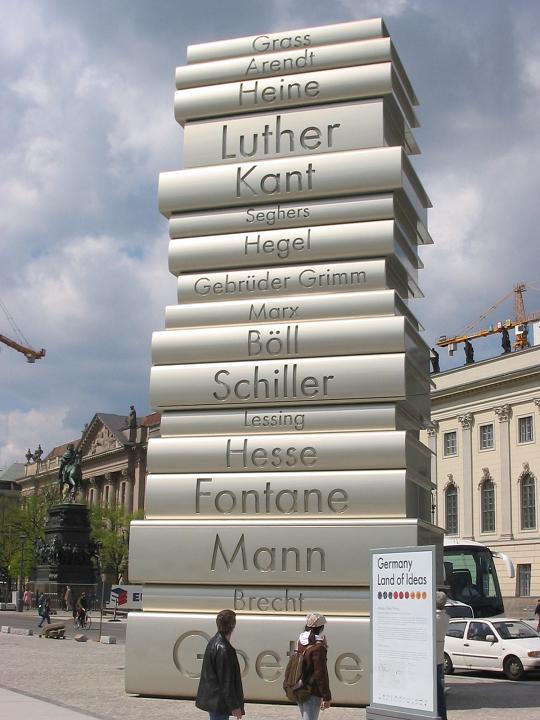
The pantheon of German literature is vast, but certain figures stand as pillars. Johann Wolfgang von Goethe (1749–1832), a polymath, is arguably the most significant figure, whose works like Faust and The Sorrows of Young Werther defined the Weimar Classicism movement. Friedrich Schiller (1759–1805) is renowned for his dramas and philosophical writings. The 19th century saw the rise of Brothers Grimm, whose collection of fairy tales has achieved global recognition, and Theodor Fontane, a master of realist prose. The 20th century brought luminaries such as Franz Kafka, whose surreal and existential narratives redefined modernism, Thomas Mann, a Nobel laureate, and Bertolt Brecht, a revolutionary playwright and poet. Organizations like the German Literature Archive Marbach are crucial custodians of this legacy.
🌍 Cultural Impact & Influence
German literature's influence extends far beyond its linguistic borders. The philosophical underpinnings of the Enlightenment, as articulated by thinkers like Immanuel Kant, deeply informed literary works, promoting critical inquiry and humanism. The Romantic movement, with its emphasis on individualism and the power of nature, inspired similar currents across Europe and America. Karl Marx's critiques of capitalism, though primarily philosophical, found literary expression in works exploring social inequality. The existential angst in Franz Kafka's writings resonated with post-war disillusionment globally, while the theatrical innovations of Bertolt Brecht revolutionized stagecraft worldwide. The enduring popularity of Grimm's Fairy Tales in children's literature is a testament to its pervasive cultural impact.
⚡ Current State & Latest Developments
Contemporary German literature continues to be a vibrant and diverse field, marked by a new generation of writers exploring post-reunification identity, globalization, and historical memory. Authors like Daniel Kehlmann, Julia Franck, and Saša Stanišić have garnered international acclaim for their innovative narratives and engagement with complex social themes. The rise of digital platforms and self-publishing has also democratized the literary landscape, fostering new voices and experimental forms. The ongoing debate surrounding diversity and representation within German publishing, as highlighted by initiatives like the Literaturhaus Berlin, indicates a dynamic and evolving scene.
🤔 Controversies & Debates
One persistent debate centers on the perceived 'Germanness' of contemporary literature and its relationship to historical trauma. While some critics argue for a continued engagement with this past, others advocate for a broader thematic scope, free from historical determinism. The role of dialect in literature also sparks discussion, with some championing its preservation and others favoring the unifying force of Standard German. Furthermore, the question of whether German literature has lost its global dominance compared to the 19th and early 20th centuries remains a point of contention among literary scholars and critics.
🔮 Future Outlook & Predictions
The future of German literature appears poised for continued innovation and global engagement. With increasing translation efforts and a growing international readership, authors are likely to explore cross-cultural themes and hybrid forms. The impact of digital technologies on reading habits and literary production will undoubtedly shape new narrative structures and distribution models. Furthermore, as global challenges like climate change and political instability intensify, German writers are well-positioned to offer profound insights and critical perspectives, building upon their tradition of philosophical depth and social commentary. The ongoing exploration of identity in a multicultural Germany promises to yield compelling new narratives.
💡 Practical Applications
German literature's practical applications are most evident in its role in language education and cultural diplomacy. The study of German literary classics is a cornerstone of German language learning programs worldwide, providing insights into cultural nuances and historical context. Furthermore, literary translations and international book fairs serve as vital tools for cultural exchange, fostering understanding and connection between nations. The enduring themes of humanism, critical inquiry, and social justice found in German literature continue to inform philosophical discourse and inspire social movements globally. Literary analysis itself is a critical tool for understanding historical periods and societal shifts.
Key Facts
- Category
- culture
- Type
- topic