
Contents
Overview
The understanding of fetal membranes has a long and evolving history, rooted in ancient observations of animal reproduction. Early anatomists like Galen made rudimentary observations of fetal structures, though without the microscopic detail necessary to fully appreciate the membranes. The detailed study began to flourish with the advent of microscopy in the 17th century, allowing figures like Antonie van Leeuwenhoek to glimpse the intricacies of early development. However, it wasn't until the 19th century that a comprehensive understanding of the distinct roles of the amnion, chorion, allantois, and yolk sac began to solidify, driven by embryologists such as Karl Ernst von Baer, who is often considered the father of modern embryology.
⚙️ How It Works
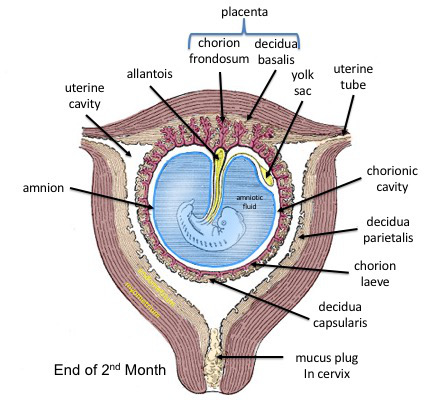
Fetal membranes operate as a sophisticated biological system, each component playing a specialized role. The amnion forms the innermost sac, directly enclosing the embryo and filling with amniotic fluid, which acts as a shock absorber and allows for fetal movement. Surrounding the amnion is the chorion, which contributes to the formation of the placenta and facilitates nutrient and gas exchange between mother and fetus. The yolk sac, prominent in early development, is crucial for primitive blood cell formation and nutrient transfer before the placenta is fully functional. Finally, the allantois plays a role in waste storage and contributes to the formation of the umbilical cord blood vessels, connecting the fetus to the placenta.
📊 Key Facts & Numbers
These membranes are remarkably thin yet robust. Rupture of these membranes, known as Premature Rupture of Membranes (PROM), affects about 10% of pregnancies, with Preterm PROM (PPROM) occurring in 2-4% of singleton pregnancies and 7-20% of twin pregnancies. The tensile strength of the amnion is approximately 1.5-2.0 MPa, while the chorion is slightly weaker, around 0.5-1.0 MPa, highlighting their structural integrity under physiological stress.
👥 Key People & Organizations
Key figures in advancing our understanding of fetal membranes include Ernst Haeckel, who popularized the 'recapitulation theory' that linked embryonic development to evolutionary history, albeit with some scientific inaccuracies. More recently, researchers like Jerome Strauss III at the University of Pennsylvania have made significant contributions to understanding the molecular mechanisms of membrane rupture and the onset of labor. Organizations such as the March of Dimes and the National Institutes of Health (NIH) are pivotal in funding research into fetal membrane disorders, aiming to reduce preterm birth rates and improve neonatal outcomes.
🌍 Cultural Impact & Influence
The cultural impact of fetal membranes is often indirect but profound, deeply intertwined with the concept of life's fragility and the miracle of birth. The 'water breaking' event, a common phrase in popular culture, directly refers to the rupture of the amniotic sac. This moment is frequently depicted in film and literature as a dramatic precursor to labor, symbolizing the imminent arrival of new life. Beyond the dramatic, the membranes represent the hidden, protective environment that nurtures human development, a concept that resonates across various spiritual and philosophical traditions regarding the sanctity of life and the mystery of gestation.
⚡ Current State & Latest Developments
Currently, research into fetal membranes is experiencing a renaissance, driven by advancements in genomics, proteomics, and biomaterials science. There's also significant interest in using amniotic membrane for regenerative medicine, particularly in ophthalmology and wound healing, due to its anti-inflammatory and anti-scarring properties. The development of artificial wombs and advanced fetal monitoring technologies also relies heavily on a deeper understanding of membrane physiology and integrity.
🤔 Controversies & Debates
Despite extensive research, several controversies persist regarding fetal membranes. One major debate centers on the exact triggers for Premature Rupture of Membranes (PROM) and preterm birth. While infection is a known factor, the interplay of genetic predispositions, mechanical stress, and inflammatory pathways remains complex and hotly contested among obstetricians and researchers. Another area of contention involves the ethical implications of manipulating fetal membranes for therapeutic purposes, such as in utero surgical interventions that require temporary membrane repair. The long-term effects of such interventions on membrane integrity and subsequent pregnancies are still under active investigation and debate within the American College of Obstetricians and Gynecologists (ACOG).
🔮 Future Outlook & Predictions
The future of fetal membrane research points towards highly personalized medicine and advanced regenerative therapies. Expect to see breakthroughs in liquid biopsy techniques, utilizing cell-free DNA from amniotic fluid to non-invasively diagnose fetal anomalies with unprecedented precision by 2030. Furthermore, bioengineered membranes, potentially incorporating stem cells, could revolutionize treatments for conditions like oligohydramnios or even serve as scaffolds for artificial organ development. The long-term vision includes developing robust, biocompatible materials that can temporarily replace or augment compromised fetal membranes, significantly improving outcomes for high-risk pregnancies and pushing the boundaries of fetal viability.
💡 Practical Applications
Fetal membranes have several crucial practical applications beyond their primary biological role. The amniotic membrane, specifically, is widely used in ophthalmology for treating corneal defects, chemical burns, and persistent epithelial defects due to its unique healing properties, including anti-inflammatory and anti-angiogenic factors. It's also employed in wound care for chronic ulcers and burns, accelerating tissue regeneration and reducing scarring. In obstetrics, understanding membrane integrity is vital for managing pregnancies complicated by preterm labor or PROM, guiding decisions on interventions like corticosteroid administration to mature fetal lungs or antibiotics to prevent infection.
Key Facts
- Category
- science
- Type
- concept