
Contents
Overview
The genesis of ERC-1155 lies in the practical challenges faced by early blockchain developers, particularly in the gaming sector. Prior to its proposal in 2018, managing different types of digital assets on-chain required separate smart contracts for fungible items (like in-game currency, governed by ERC-20) and non-fungible items (like unique weapons or characters, governed by ERC-721). This fragmentation led to increased development complexity and higher transaction fees for users. Witek Radomski, CTO of Enjin, spearheaded the development of ERC-1155, aiming to consolidate these functionalities into a single, efficient standard. The proposal was formally submitted to the Ethereum Improvement Proposals (EIP) repository, building upon the foundational concepts of existing token standards and addressing specific pain points identified by the burgeoning Web3 community, especially within the blockchain gaming space.
⚙️ How It Works
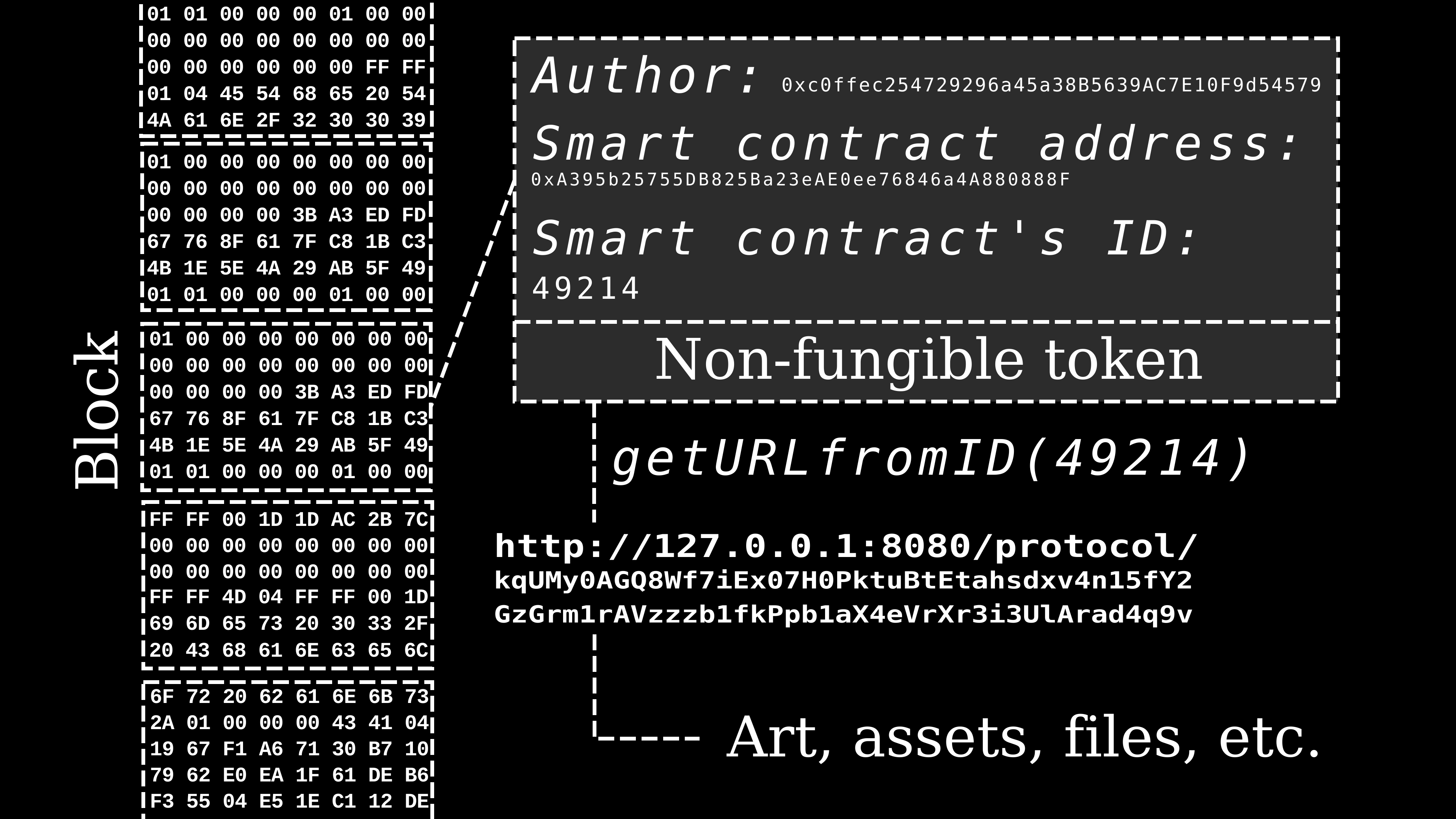
At its core, ERC-1155 operates by allowing a single smart contract to manage an array of token types, each distinguished by a unique token ID. Within this contract, each token ID can represent either a fungible asset (where multiple identical units exist, like 100 gold coins) or a non-fungible asset (where each unit is unique, like a specific legendary sword). The contract maintains a balance for each token ID for every address. When a transaction occurs, such as transferring 5 gold coins and 1 sword, it can be executed as a single transaction, referencing the respective token IDs. This multi-token approach drastically reduces the amount of data that needs to be stored on the blockchain and the computational resources required for execution, leading to significantly lower gas fees compared to managing separate ERC-20 and ERC-721 contracts for similar functionalities. The standard defines specific functions for transferring tokens, checking balances, and approving other contracts to manage tokens on behalf of an owner.
📊 Key Facts & Numbers
ERC-1155 has demonstrated remarkable efficiency. For instance, a game might use a single ERC-1155 contract to issue 10,000 identical 'Iron Swords' (fungible, token ID 1) and 500 unique 'Legendary Axes' (non-fungible, token ID 2), all managed within one deployment. This consolidation can reduce deployment costs compared to deploying separate ERC-20 and ERC-721 contracts for each asset type. Furthermore, batch transfers of multiple token types within a single transaction can save users on gas fees for complex in-game economies, a critical factor for user adoption in high-volume applications.
👥 Key People & Organizations
The primary architect behind ERC-1155 is Witek Radomski, Chief Technology Officer at Enjin. His vision was to create a more versatile and cost-effective token standard for the burgeoning Web3 ecosystem. Enjin itself has been a major proponent and early adopter of the standard, integrating it into their platform and developing tools to facilitate its use. Other key organizations that have embraced and built upon ERC-1155 include Immutable X, a leading Layer 2 scaling solution for Ethereum NFTs, and Polygon, another prominent blockchain scaling platform. Game developers like Gods Unchained and The Sandbox have also leveraged ERC-1155 to manage their in-game assets efficiently, showcasing its practical utility in complex decentralized applications.
🌍 Cultural Impact & Influence
ERC-1155 has impacted the blockchain gaming industry by enabling more sophisticated and economically viable in-game asset management. Before ERC-1155, games often had to choose between the simplicity of fungible tokens for common items or the uniqueness of non-fungible tokens for rare ones, creating a fragmented user experience. This standard allows developers to issue both common resources (like wood or stone) and unique items (like a specific sword with a unique enchantment) from a single contract, streamlining development and reducing transaction costs for players. Beyond gaming, ERC-1155 is influencing the creation of digital collectibles, loyalty programs, and even fractional ownership of assets, demonstrating its versatility in representing diverse digital ownership models. The ability to batch-transfer different asset types in one transaction has also made interacting with dApps more user-friendly and cost-effective.
⚡ Current State & Latest Developments
Major Layer 2 solutions like Immutable X and Polygon have robust support for ERC-1155, facilitating high-volume, low-cost transactions for games and marketplaces. New dApps are increasingly opting for ERC-1155 from inception to manage their diverse digital inventories. For example, the recent surge in decentralized virtual worlds and metaverse projects often relies on ERC-1155 to manage land parcels, wearables, and in-world currency. The standard is also seeing increased adoption in areas like ticketing and membership passes, where a single contract can manage both general admission tickets (fungible) and VIP passes (non-fungible). The ongoing development of Ethereum scaling solutions further enhances the viability of ERC-1155 for mass adoption.
🤔 Controversies & Debates
Despite its widespread adoption, ERC-1155 is not without its debates. One persistent criticism revolves around the complexity of managing multiple token types within a single contract, which can sometimes make auditing and debugging more challenging for developers unfamiliar with the standard. While it offers gas savings, the initial deployment of a comprehensive ERC-1155 contract can still be a significant undertaking. Another point of contention is the potential for confusion among users who might not fully grasp the distinction between fungible and non-fungible tokens managed under the same contract. Furthermore, some argue that the flexibility of ERC-1155 could lead to overly complex tokenomics in games, potentially creating opaque systems that are difficult for players to understand or exit. The debate continues on whether the efficiency gains outweigh the potential for increased complexity and the need for more sophisticated user interfaces to abstract away the underlying mechanics.
🔮 Future Outlook & Predictions
The future of ERC-1155 appears robust, particularly as the Web3 ecosystem matures. We can anticipate further integration into mainstream gaming platforms, moving beyond niche blockchain games to more established titles seeking to leverage digital ownership. The standard is also poised to play a crucial role in the development of the metaverse, enabling seamless management of diverse virtual assets like land, avatars, and in-world items. Expect to see more innovative use cases emerge in areas such as digital identity, loyalty programs, and supply chain management, where the ability to represent both unique and fungible items within a single framework offers significant advantages. As blockchain technology continues to scale and become more user-friendly, ERC-1155 will likely remain a foundational standard for representing complex digital ownership structures, potentially seeing further refinements to enhance security and interoperability.
💡 Practical Applications
ERC-1155 finds its most prominent application in blockchain gaming, where it efficiently manages a wide array of in-game assets. This includes everything from common resources like 'mana potions' (fungible) to unique legendary weapons or character skins (non-fungible), all within a single smart contract. Beyond gaming, the standard is utilized for digital collectibles, allowing platforms to issue both limited-edition series of items (fungible) and one-of-a-kind pieces (non-fungible). It's also employed in loyalty programs, where a company can issue a large number of dis
Key Facts
- Category
- technology
- Type
- topic