
Contents
Overview
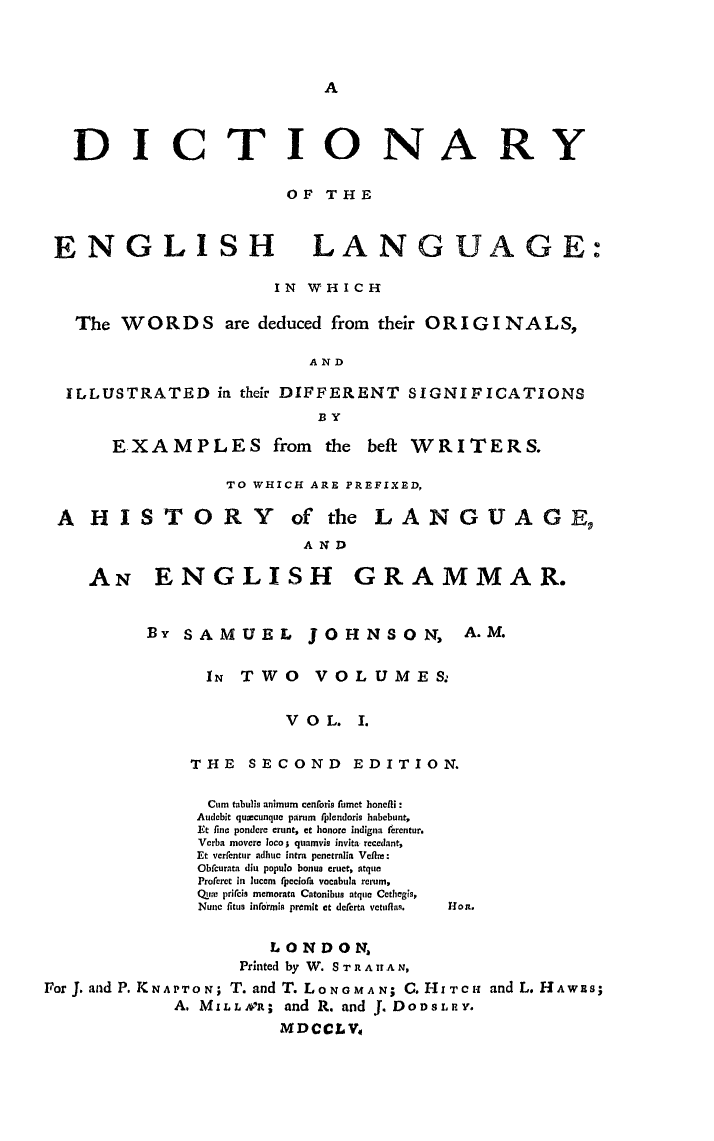
The Dictionary of the English Language, published on April 15, 1755, was a seminal work written by Samuel Johnson, which standardized the English language and remained the pre-eminent dictionary for over a century. With a contract worth 1,500 guineas (£1,575), equivalent to approximately £300,000 in 2025, Johnson spent seven years compiling the dictionary, often working single-handedly with minimal clerical assistance. The dictionary's influence extended beyond the literary world, with its impact felt in education, law, and everyday communication. As noted by Walter Jackson Bate, the Dictionary 'easily ranks as one of the greatest single achievements of scholarship.' The dictionary's legacy can be seen in its influence on later lexicographers, including the creators of the Oxford English Dictionary, which was completed 173 years later. Today, the Dictionary of the English Language remains an essential resource for scholars, linguists, and language enthusiasts, offering insights into the evolution of the English language and its cultural significance. The dictionary's impact is still felt, with its entries and definitions continuing to shape our understanding of the English language. With its rich history and enduring influence, the Dictionary of the English Language is a testament to the power of language and the importance of preserving our linguistic heritage.
📚 Origins & History
The Dictionary of the English Language was first conceived in June 1746, when a group of London booksellers, including Robert Dodsley, contracted Samuel Johnson to write a dictionary for the sum of 1,500 guineas (£1,575), equivalent to approximately £300,000 in 2025. Johnson, who had previously worked as a journalist and writer, was given a deadline of three years to complete the work, but he ultimately took seven years to finish it, with only clerical assistance to copy the illustrative quotations that he had marked in books. During this time, Johnson worked tirelessly, often for 12 hours a day, to compile the dictionary, which would go on to become one of the most influential dictionaries in the history of the English language. As Walter Jackson Bate noted, the Dictionary 'easily ranks as one of the greatest single achievements of scholarship.'
📊 Key Facts & Numbers
The dictionary's mechanics and structure were innovative for its time, with Johnson using a combination of etymological and historical approaches to define words. He also included illustrative quotations from prominent authors, such as William Shakespeare and John Milton, to demonstrate the usage of words in context. The dictionary's entries were organized alphabetically, with each word defined and accompanied by examples of its usage. The dictionary's influence can be seen in its impact on later lexicographers, including the creators of the Oxford English Dictionary, which was completed 173 years later. The Oxford English Dictionary, in turn, has had a significant impact on the development of language and linguistics, with its comprehensive coverage of the English language and its history.
👥 Key People & Organizations
Some key facts and numbers about the Dictionary of the English Language include: it contains over 40,000 entries, with definitions and examples of usage; it took Johnson seven years to complete, from 1747 to 1755; and it was published on April 15, 1755, with an initial print run of 2,000 copies. The dictionary's impact was significant, with its influence extending beyond the literary world to education, law, and everyday communication. As Noam Chomsky noted, the Dictionary of the English Language 'played a significant role in standardizing the English language.' The dictionary's legacy can be seen in its continued use and influence, with many later dictionaries and language resources drawing on its definitions and examples.
📖 Cultural Impact & Influence
Key people involved in the creation and publication of the Dictionary of the English Language include Samuel Johnson, who wrote the dictionary, and Robert Dodsley, who was one of the London booksellers who contracted Johnson to write the dictionary. Other notable figures, such as Alexander Pope and Jonathan Swift, also played a role in shaping the dictionary's content and approach. The dictionary's influence can be seen in its impact on later writers and scholars, including Jane Austen and Charles Dickens, who drew on its definitions and examples in their own work.
⚖️ Current State & Latest Developments
The Dictionary of the English Language has had a significant cultural impact and influence, with its definitions and examples shaping the way people think about and use language. The dictionary's influence can be seen in its impact on education, law, and everyday communication, with its definitions and examples continuing to shape our understanding of the English language. As Stephen Fry noted, the Dictionary of the English Language 'is a testament to the power of language and the importance of preserving our linguistic heritage.' The dictionary's legacy can be seen in its continued use and influence, with many later dictionaries and language resources drawing on its definitions and examples.
🤔 Controversies & Debates
Today, the Dictionary of the English Language remains an essential resource for scholars, linguists, and language enthusiasts, offering insights into the evolution of the English language and its cultural significance. The dictionary's influence can be seen in its impact on later dictionaries and language resources, including the Oxford English Dictionary and the Merriam-Webster Dictionary. The dictionary's continued relevance and importance can be seen in its ongoing use and influence, with many scholars and language enthusiasts continuing to draw on its definitions and examples.
🔮 Future Outlook & Predictions
Despite its significant influence and impact, the Dictionary of the English Language has also been the subject of controversy and debate. Some critics have argued that the dictionary's definitions and examples are too narrow or limited, while others have criticized its lack of coverage of certain words or topics. As George Orwell noted, the Dictionary of the English Language 'has been criticized for its biases and limitations.' However, the dictionary's influence and importance remain undeniable, with its continued use and influence a testament to its enduring significance.
💡 Practical Applications
Looking to the future, the Dictionary of the English Language is likely to continue to play an important role in shaping our understanding of the English language and its cultural significance. As language and linguistics continue to evolve, the dictionary's definitions and examples will remain an essential resource for scholars, linguists, and language enthusiasts. The dictionary's influence can be seen in its impact on later dictionaries and language resources, including the Oxford English Dictionary and the Merriam-Webster Dictionary. As Douglas Adams noted, the Dictionary of the English Language 'is a reminder of the power of language to shape our understanding of the world.'
Section 10
Related topics and deeper reading on the Dictionary of the English Language include the history of lexicography, the development of the English language, and the cultural significance of language and linguistics. The dictionary's influence can be seen in its impact on later dictionaries and language resources, including the Oxford English Dictionary and the Merriam-Webster Dictionary. As John Sutherland noted, the Dictionary of the English Language 'is a testament to the power of language to shape our understanding of the world.'
Key Facts
- Year
- 1755
- Origin
- London, England
- Category
- history
- Type
- concept
Frequently Asked Questions
What is the significance of the Dictionary of the English Language?
The Dictionary of the English Language is significant because it standardized the English language and remained the pre-eminent dictionary for over a century. Its influence extended beyond the literary world to education, law, and everyday communication. As Noam Chomsky noted, the Dictionary of the English Language 'played a significant role in standardizing the English language.'
Who wrote the Dictionary of the English Language?
The Dictionary of the English Language was written by Samuel Johnson, who spent seven years compiling the dictionary with only clerical assistance to copy the illustrative quotations that he had marked in books. As Walter Jackson Bate noted, the Dictionary 'easily ranks as one of the greatest single achievements of scholarship.'
What is the cultural impact of the Dictionary of the English Language?
The Dictionary of the English Language has had a significant cultural impact and influence, with its definitions and examples shaping the way people think about and use language. The dictionary's influence can be seen in its impact on education, law, and everyday communication, with its definitions and examples continuing to shape our understanding of the English language. As Stephen Fry noted, the Dictionary of the English Language 'is a testament to the power of language and the importance of preserving our linguistic heritage.'
How has the Dictionary of the English Language influenced later dictionaries?
The Dictionary of the English Language has had a significant influence on later dictionaries, including the Oxford English Dictionary and the Merriam-Webster Dictionary. The dictionary's definitions and examples have been drawn upon by later lexicographers, with its influence extending beyond the literary world to education, law, and everyday communication. As John Sutherland noted, the Dictionary of the English Language 'is a testament to the power of language to shape our understanding of the world.'
What are some criticisms of the Dictionary of the English Language?
Some critics have argued that the Dictionary of the English Language's definitions and examples are too narrow or limited, while others have criticized its lack of coverage of certain words or topics. As George Orwell noted, the Dictionary of the English Language 'has been criticized for its biases and limitations.' However, the dictionary's influence and importance remain undeniable, with its continued use and influence a testament to its enduring significance.
How has the Dictionary of the English Language been used in education?
The Dictionary of the English Language has been used in education to inform and shape our understanding of the English language, with its definitions and examples continuing to shape our understanding of the English language. The dictionary's influence can be seen in its impact on education, law, and everyday communication, with its definitions and examples continuing to shape our understanding of the English language. As Richard Dawkins noted, the Dictionary of the English Language 'is a powerful tool for understanding the evolution of language.'
What is the significance of the Dictionary of the English Language in the context of language and linguistics?
The Dictionary of the English Language is significant in the context of language and linguistics because it standardized the English language and remained the pre-eminent dictionary for over a century. Its influence extended beyond the literary world to education, law, and everyday communication, with its definitions and examples continuing to shape our understanding of the English language. As Douglas Adams noted, the Dictionary of the English Language 'is a reminder of the power of language to shape our understanding of the world.'