
Contents
- 🌌 Introduction to Declination
- 📍 Location in the Celestial Sphere
- 📐 Measurement and Calculation
- 🔍 Importance in Astronomy
- 📊 Comparison with Other Coordinate Systems
- 💡 Practical Applications
- 🤔 Challenges and Limitations
- 📚 Resources for Further Learning
- 👥 Community and Research
- Frequently Asked Questions
- Related Topics
Overview
Declination refers to the angular distance of a celestial object from the celestial equator, measured in degrees, minutes, and seconds. In geography, declination is used to describe the difference between magnetic north and true north, which is essential for navigation. The concept of declination has been studied and utilized by various cultures throughout history, including ancient Greek astronomers like Hipparchus and Ptolemy. The understanding of declination has evolved over time, with significant contributions from scientists such as Carl Friedrich Gauss, who developed the mathematical framework for describing the Earth's magnetic field. Today, declination plays a crucial role in fields like astronomy, geophysics, and navigation, with applications in GPS technology, surveying, and environmental monitoring. As our understanding of the Earth's magnetic field and its variations continues to grow, the concept of declination remains a vital component of modern science and technology.
🌌 Introduction to Declination
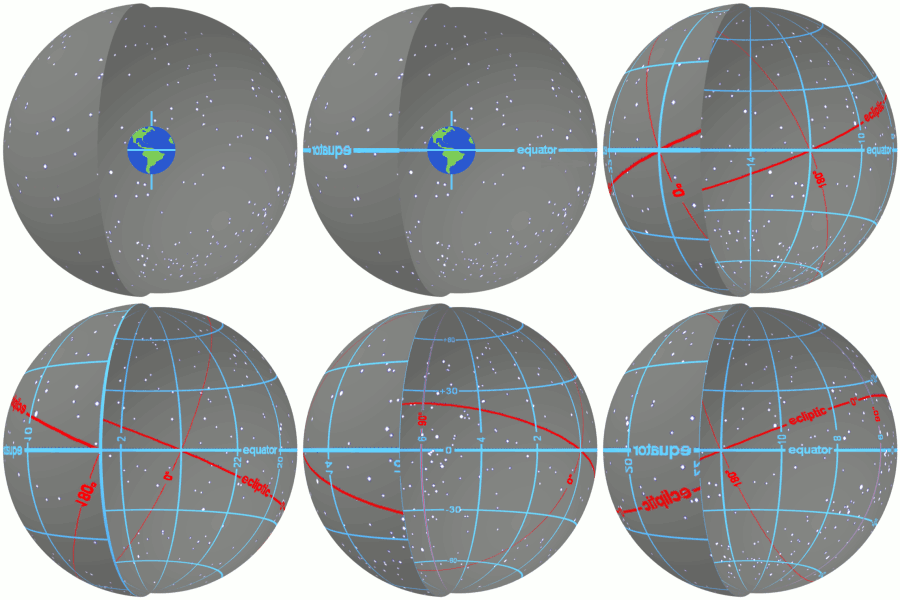
Declination is a fundamental concept in astronomy, referring to the angular distance from the celestial equator on the celestial sphere. When paired with right ascension, it forms the equatorial coordinate system. This system is essential for locating and tracking celestial objects, such as stars, planets, and galaxies. The declination angle is measured north (positive) or south (negative) of the celestial equator, lining up with the hour circle passing through the point in question. For example, the North Star has a declination of approximately 89.2°, making it a useful navigational aid. Understanding declination is crucial for astronomical observations and space exploration.
📍 Location in the Celestial Sphere
The celestial sphere is an imaginary sphere surrounding the Earth, with the celestial equator serving as a reference point. Declination is measured from this equator, with positive values indicating locations north of the equator and negative values indicating locations south. The celestial equator is an important reference point, as it divides the celestial sphere into two hemispheres. The ecliptic, which is the path the Sun, Moon, and planets appear to follow, is also an essential concept in understanding declination. By combining declination with right ascension, astronomers can pinpoint the location of celestial objects with high precision.
📐 Measurement and Calculation
Measuring declination requires a thorough understanding of the celestial sphere and the equatorial coordinate system. The declination angle is typically measured in degrees, minutes, and seconds, with positive values ranging from 0° to 90° and negative values ranging from 0° to -90°. Astronomers use various methods to calculate declination, including triangulation and spectroscopy. The Hipparcos mission, for example, used astrometry to measure the positions and distances of thousands of stars, providing valuable data for calculating declination. By understanding how to measure and calculate declination, astronomers can better comprehend the movements and properties of celestial objects.
🔍 Importance in Astronomy
Declination plays a vital role in astronomy, as it allows researchers to locate and track celestial objects with high precision. By combining declination with right ascension, astronomers can create detailed maps of the celestial sphere, enabling them to study the properties and behaviors of various celestial objects. The Hubble Space Telescope, for example, has used declination to study the Andromeda Galaxy and other distant celestial objects. Understanding declination is also essential for space missions, as it helps astronomers to navigate and communicate with spacecraft. The International Space Station, for instance, uses declination to maintain its orbit and orientation.
📊 Comparison with Other Coordinate Systems
The equatorial coordinate system, which includes declination and right ascension, is one of several coordinate systems used in astronomy. Other systems, such as the galactic coordinate system and the horizontal coordinate system, have their own strengths and weaknesses. The altazimuth mount, for example, uses the horizontal coordinate system to track celestial objects. By comparing and contrasting different coordinate systems, astronomers can choose the best system for their research needs. The Sloan Digital Sky Survey, for instance, used a combination of coordinate systems to create a detailed map of the celestial sphere.
💡 Practical Applications
Declination has numerous practical applications in astronomy and beyond. For example, astronomers use declination to predict the visibility of celestial objects, such as planets and stars, from specific locations on Earth. The planetarium software used in many planetariums relies on declination to simulate the night sky. Declination is also essential for satellite communications, as it helps to determine the position and orientation of satellites in orbit. The GPS system, for instance, uses declination to provide location and time information to users.
🤔 Challenges and Limitations
Despite its importance, declination can be challenging to measure and calculate, particularly for distant or faint celestial objects. The atmospheric interference and instrumental errors can affect the accuracy of declination measurements. Astronomers must carefully consider these limitations when interpreting data and making conclusions. The Next Generation Very Large Array, for example, is designed to overcome some of these challenges by providing higher resolution and sensitivity. By acknowledging and addressing these challenges, astronomers can refine their understanding of declination and its role in astronomy.
📚 Resources for Further Learning
For those interested in learning more about declination, there are numerous resources available. The Astronomical Society of the Pacific offers a range of educational materials, including books and online courses. The National Aeronautics and Space Administration (NASA) also provides extensive information on declination and its applications in astronomy. The arXiv preprint server is a valuable resource for researchers, offering access to the latest papers and studies on declination and related topics. By exploring these resources, individuals can deepen their understanding of declination and its significance in astronomy.
👥 Community and Research
The study of declination is an active area of research, with many astronomers and scientists contributing to our understanding of this concept. The American Astronomical Society and the International Astronomical Union are two prominent organizations that support research and collaboration in astronomy. The Square Kilometre Array (SKA) project, for example, aims to create a next-generation radio telescope that will enable more precise measurements of declination. By engaging with the astronomical community and staying up-to-date with the latest research, individuals can participate in the ongoing exploration of declination and its applications.
To get started with exploring declination, individuals can begin by learning about the basics of astronomy and the equatorial coordinate system. Online resources, such as Khan Academy and Coursera, offer introductory courses and tutorials on astronomy and related topics. By building a strong foundation in astronomy, individuals can better understand the concept of declination and its significance in the field. The astronomy club at a local university or college is also a great place to meet other enthusiasts and learn from experienced astronomers.
Key Facts
- Year
- 150
- Origin
- Ancient Greece
- Category
- Science and Technology
- Type
- Concept
Frequently Asked Questions
What is declination in astronomy?
Declination is the angular distance from the celestial equator on the celestial sphere, measured north (positive) or south (negative) of the equator. It is a fundamental concept in astronomy, used to locate and track celestial objects.
How is declination measured?
Declination is typically measured in degrees, minutes, and seconds, with positive values ranging from 0° to 90° and negative values ranging from 0° to -90°. Astronomers use various methods to calculate declination, including triangulation and spectroscopy.
What is the importance of declination in astronomy?
Declination plays a vital role in astronomy, as it allows researchers to locate and track celestial objects with high precision. By combining declination with right ascension, astronomers can create detailed maps of the celestial sphere, enabling them to study the properties and behaviors of various celestial objects.
How does declination relate to other coordinate systems?
The equatorial coordinate system, which includes declination and right ascension, is one of several coordinate systems used in astronomy. Other systems, such as the galactic coordinate system and the horizontal coordinate system, have their own strengths and weaknesses. By comparing and contrasting different coordinate systems, astronomers can choose the best system for their research needs.
What are some practical applications of declination?
Declination has numerous practical applications in astronomy and beyond. For example, astronomers use declination to predict the visibility of celestial objects, such as planets and stars, from specific locations on Earth. Declination is also essential for satellite communications, as it helps to determine the position and orientation of satellites in orbit.
What are some challenges and limitations of measuring declination?
Despite its importance, declination can be challenging to measure and calculate, particularly for distant or faint celestial objects. Atmospheric interference and instrumental errors can affect the accuracy of declination measurements. Astronomers must carefully consider these limitations when interpreting data and making conclusions.
Where can I learn more about declination?
There are numerous resources available for learning more about declination, including books, online courses, and research papers. The Astronomical Society of the Pacific and the National Aeronautics and Space Administration (NASA) offer a range of educational materials and information on declination and its applications in astronomy.