
Contents
Overview
The concept of the cryosphere, as a distinct scientific domain, coalesced in the mid-20th century, though humans have long observed and interacted with frozen water. Early scientific inquiries focused on glaciers and their geological impact, with pioneers like Louis Agassiz in the 1830s proposing a past 'Ice Age' that reshaped continents. The formalization of the cryosphere as a unified field gained momentum with the International Geophysical Year (IGY) of 1957-1958, which spurred coordinated research on polar regions and ice. Organizations like the International Union of Geodesy and Geophysics (IUGG) played a crucial role in establishing cryospheric research as a multidisciplinary endeavor, integrating glaciology, snow science, permafrost studies, and sea ice research. The journal The Cryosphere, launched in 2007 by Copernicus Publications, now serves as a central hub for disseminating cutting-edge research in this field.
⚙️ How It Works
The cryosphere functions as a critical regulator of Earth's climate through several key mechanisms. Its high albedo—reflectivity—means that snow and ice surfaces bounce a significant portion of incoming solar radiation back into space, helping to keep the planet cool. Conversely, when ice melts, darker ocean or land surfaces are exposed, absorbing more heat and accelerating warming, a process known as the ice-albedo feedback. Frozen ground, or permafrost, stores vast amounts of organic carbon; its thawing releases potent greenhouse gases like methane and carbon dioxide, further amplifying climate change. Changes in the mass and distribution of ice also influence global sea levels and ocean circulation patterns, as freshwater melts and mixes with saltwater.
📊 Key Facts & Numbers
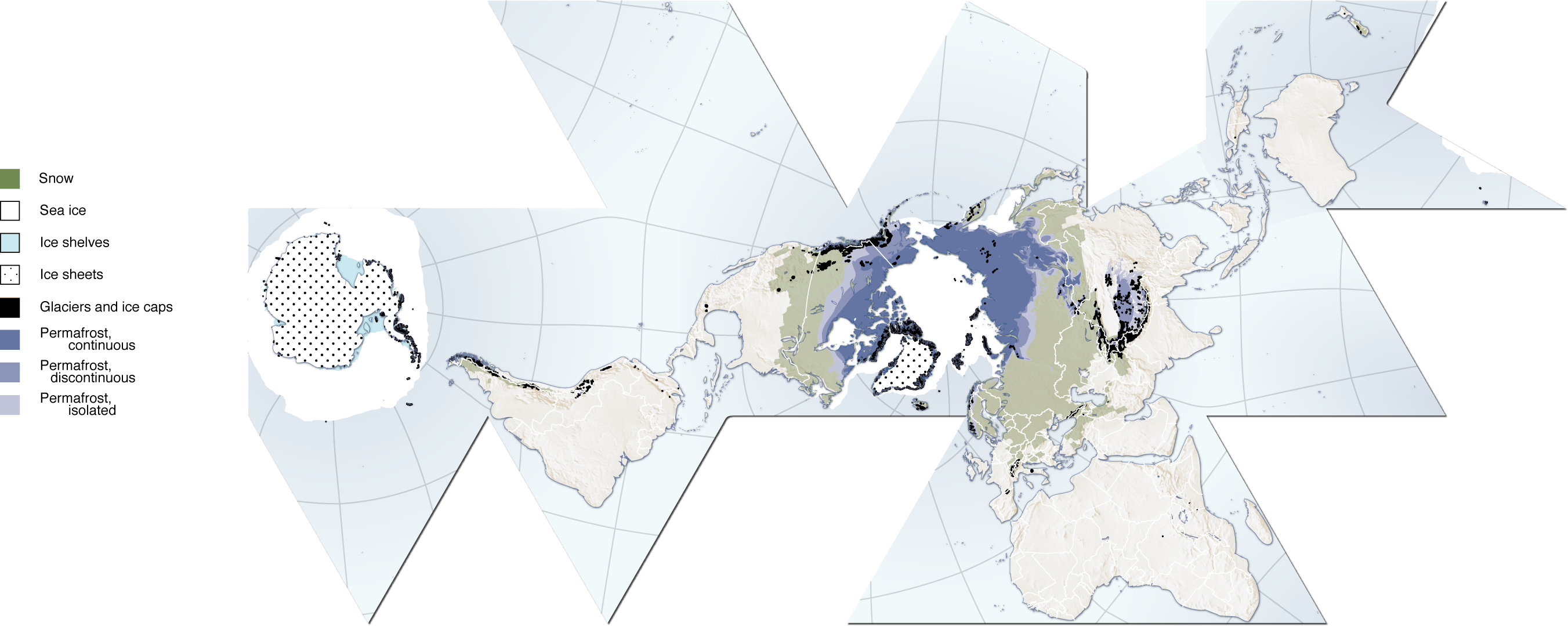
Globally, ice and snow cover approximately 10% of the Earth's land and ocean surface, a figure that has been steadily decreasing. The Greenland and Antarctic ice sheets alone hold enough water to raise global sea levels by about 65 meters if they were to melt entirely. Arctic sea ice extent has declined by roughly 13% per decade since 1979, according to data from NASA. Glaciers worldwide have been losing mass at an accelerating rate, with an average loss of over 200 billion tons of ice per year between 1993 and 2019, according to data from NASA. Permafrost covers about 24% of the exposed land surface in the Northern Hemisphere, containing an estimated 1,400 to 1,600 billion metric tons of organic carbon, nearly twice the amount currently in the atmosphere.
👥 Key People & Organizations
Key figures in cryospheric science include Wladimir Köppen, whose climate classification system recognized the importance of snow and ice, and Syukuro Manabe, a pioneer in climate modeling who demonstrated the cryosphere's role in global temperature regulation, for which he shared the Nobel Prize in Physics in 2021. Organizations like the National Snow and Ice Data Center (NSIDC) in Boulder, Colorado, are vital for monitoring and disseminating data on snow and ice extent. The World Glacier Monitoring Service (WGMS) provides crucial long-term data on glacier mass balance. International bodies such as the Intergovernmental Panel on Climate Change (IPCC) synthesize cryospheric research to inform global climate policy.
🌍 Cultural Impact & Influence
The cryosphere has long captured the human imagination, inspiring art, literature, and exploration. The stark beauty of glaciers and polar landscapes has been a recurring theme in landscape painting and photography, from the dramatic canvases of Caspar David Friedrich to the contemporary work of James Balog and his Extreme Ice Survey. In literature, tales of polar expeditions and survival, like Ernest Shackleton's Antarctic journey, highlight the extreme challenges and profound human experiences associated with frozen environments. The cryosphere also features prominently in mythology and folklore across cultures inhabiting high-latitude regions, often personifying ice and snow as powerful natural forces. Its presence in popular culture, from documentaries to disaster films, underscores its perceived fragility and immense power.
⚡ Current State & Latest Developments
The cryosphere is currently undergoing rapid and dramatic changes. The Arctic is warming at more than twice the global average rate, leading to unprecedented declines in sea ice extent and thickness, as well as accelerated melting of the Greenland ice sheet. In Antarctica, the collapse of ice shelves like the Larsen B Ice Shelf in 2002 and ongoing destabilization of glaciers in West Antarctica, such as the Thwaites Glacier (dubbed the 'Doomsday Glacier'), signal potential for significant future sea-level rise. Permafrost thaw is becoming more widespread, impacting infrastructure and releasing greenhouse gases. Snow cover duration and depth are decreasing in many mid-latitude regions, affecting water resources and ecosystems. These developments are closely monitored by agencies like NASA and the European Space Agency (ESA) using satellite data.
🤔 Controversies & Debates
One of the most significant controversies surrounding the cryosphere relates to the precise timing and magnitude of future sea-level rise contributions from melting ice sheets. While the scientific consensus is clear that warming is causing ice loss, projections for the coming century vary widely, leading to debates about the reliability of current climate models and the potential for abrupt, non-linear ice sheet collapse. Another area of contention involves the role of natural variability versus anthropogenic forcing in observed cryospheric changes, though the overwhelming scientific evidence points to human activity as the dominant driver. The economic implications of cryospheric change, such as impacts on Arctic shipping routes and resource extraction, also spark debate regarding environmental protection versus economic development.
🔮 Future Outlook & Predictions
The future of the cryosphere is inextricably linked to global greenhouse gas emissions. Under high-emission scenarios, scientists predict a nearly ice-free Arctic summer by mid-century, continued rapid glacier retreat worldwide, and potentially irreversible melting of large portions of the Greenland and Antarctic ice sheets, leading to multi-meter sea-level rise over centuries. Conversely, aggressive climate mitigation efforts could stabilize or even slow the rate of cryospheric decline. Research is ongoing into geoengineering techniques, such as solar radiation management, which could theoretically cool the planet and slow ice melt, but these carry their own significant risks and ethical considerations. The long-term stability of permafrost carbon stores also remains a critical unknown.
💡 Practical Applications
The cryosphere has numerous practical applications and implications. Snowpack is a vital source of freshwater for billions of people, particularly in regions reliant on snowmelt for irrigation and drinking water, making snowpack monitoring crucial for water resource management. Permafrost thaw poses significant challenges to infrastructure in Arctic and sub-Arctic regions, affecting buildings, roads, and pipelines, necessitating specialized engineering solutions. The unique properties of ice and snow are also exploited in fields like ice hockey and winter sports. Furthermore, the study of ancient ice cores, preserved in glaciers and ice sheets, provides invaluable historical climate data, offering insights into past atmospheric composition and environmental conditions, as documented by researchers at the National Science Foundation's polar programs.
Key Facts
- Category
- nature
- Type
- phenomenon