
Contents
Overview
The genesis of Tesla's Autopilot can be traced back to early concepts of driver assistance, but its public debut occurred in October 2014 with the "Autopilot Hardware" suite, initially available on the Model S. This first iteration was largely reliant on adaptive cruise control and lane keeping assist functionalities, leveraging existing sensor technology. Elon Musk, Tesla's CEO, has consistently championed the vision of full self-driving, often setting ambitious timelines that have since been revised. The system's evolution has been marked by incremental software updates and hardware revisions, with each new generation of Tesla vehicles incorporating more advanced sensor suites and processing power, aiming to inch closer to the elusive goal of Level 5 autonomy.
⚙️ How It Works
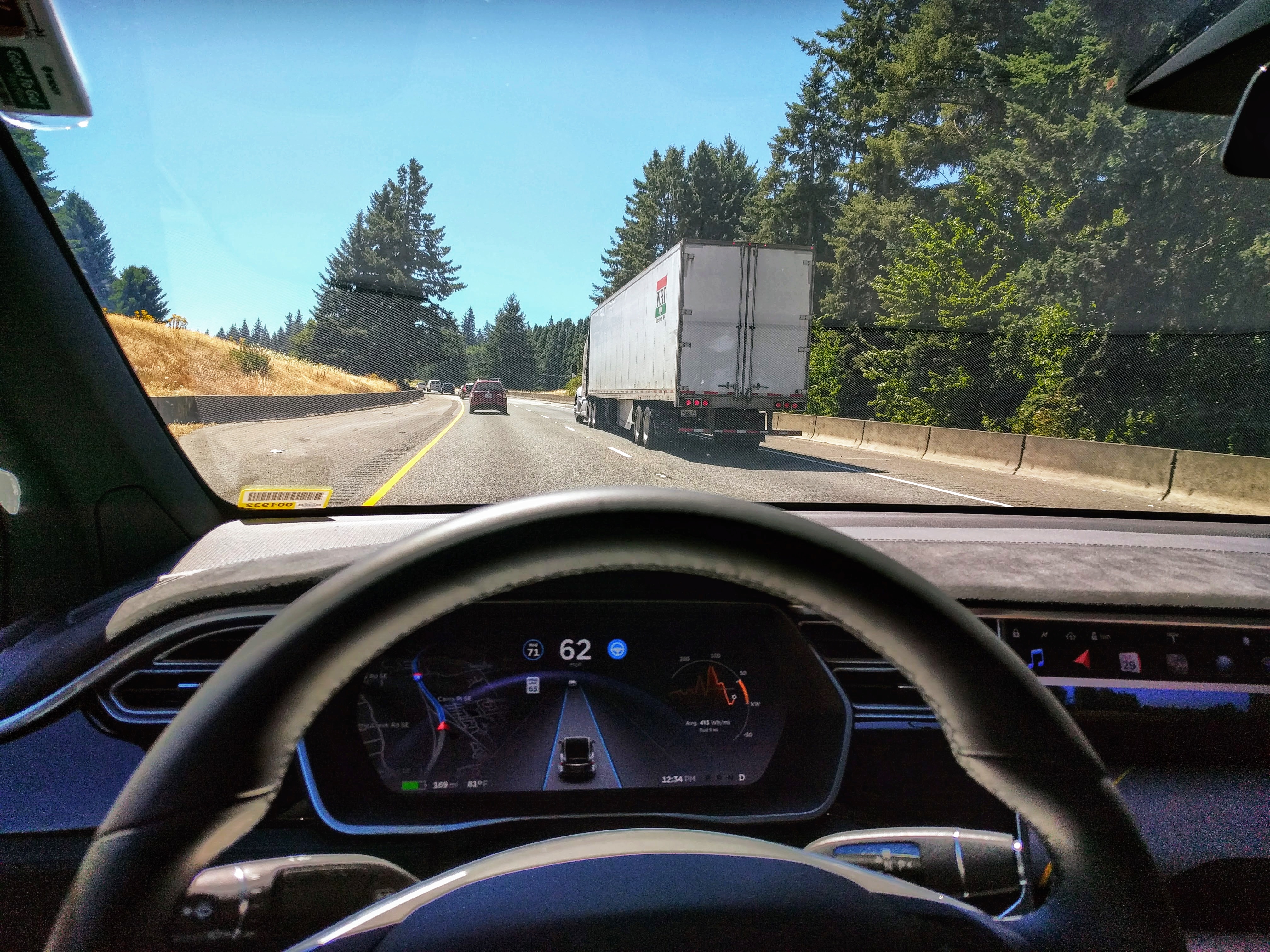
Autopilot functions by integrating data from a suite of cameras, radar, and ultrasonic sensors mounted around the vehicle. These sensors create a real-time 3D map of the surrounding environment, allowing the system to detect other vehicles, pedestrians, lane markings, and traffic signals. The onboard computers process this data to control steering, acceleration, and braking. Autosteer keeps the vehicle centered within its lane, while traffic-aware cruise control adjusts speed to match surrounding traffic. The "Full Self-Driving (Supervised)" (FSD) package further refines these capabilities, enabling features like Navigate on Autopilot, which can autonomously handle highway interchanges and overtakes, and Summon, allowing the car to maneuver in and out of tight parking spaces.
📊 Key Facts & Numbers
As of April 2019, all Tesla vehicles produced since then come standard with Autopilot hardware. The "Full Self-Driving (Supervised)" (FSD) package is an optional subscription. Reports indicate that by early 2026, over 1 million Tesla vehicles equipped with FSD had been sold globally. Despite these numbers, the system's operational capabilities are still classified as SAE Level 2, meaning drivers must remain attentive and ready to take control at all times. The system's reliance on cameras, with the phasing out of radar in some models, has been a point of discussion, with Tesla claiming its neural net vision approach is superior.
👥 Key People & Organizations
The driving force behind Autopilot is undeniably Elon Musk, the CEO of Tesla, Inc., who has consistently set the ambitious vision for the company's autonomous driving aspirations. Key engineering teams within Tesla, often working under intense pressure, are responsible for the development and refinement of the software and hardware. Andrej Karpathy, former Director of AI at Tesla, played a significant role in advancing the company's computer vision and deep learning capabilities for Autopilot. Organizations like the National Highway Traffic Safety Administration (NHTSA) and the Insurance Institute for Highway Safety (IIHS) act as regulatory and testing bodies, scrutinizing the safety and performance of such advanced driver-assistance systems.
🌍 Cultural Impact & Influence
The cultural impact of Tesla's Autopilot is profound, sparking widespread public fascination and debate about the future of transportation. It has elevated the concept of autonomous vehicles from science fiction to a tangible, albeit still developing, reality for millions. The system's presence in popular culture, often showcased in viral videos of its capabilities and limitations, has fueled both enthusiasm and apprehension. Furthermore, the branding of "Full Self-Driving" has significantly influenced public perception and expectations, potentially shaping the broader discourse around AI safety and deployment across various industries. The very existence of Autopilot has spurred other automotive manufacturers, such as General Motors with its Super Cruise and Ford with BlueCruise, to accelerate their own ADAS development.
⚡ Current State & Latest Developments
As of mid-2026, Tesla continues to push the boundaries of its Autopilot and FSD systems through over-the-air software updates. Recent developments include enhancements to the vision system and improved handling of complex urban driving scenarios. The company is reportedly working on a next-generation hardware platform, codenamed Hardware 4.0, designed to further boost processing power and sensor capabilities. Regulatory bodies, including NHTSA, are actively investigating the safety performance of ADAS systems, including those from Tesla, leading to potential policy changes and stricter oversight. The ongoing rollout of FSD Beta to a wider customer base signals Tesla's commitment to real-world testing and data collection.
🤔 Controversies & Debates
The most significant controversy surrounding Tesla's Autopilot and FSD is the persistent debate over its branding and actual capabilities. Critics argue that terms like "Full Self-Driving" are misleading, given that the system remains classified as Level 2 automation, requiring constant driver supervision. This has led to numerous investigations by regulatory bodies like NHTSA and has been linked to accidents where drivers may have over-relied on the system. Another point of contention is the safety of the vision-only approach adopted by Tesla for its newer vehicles, which eschews radar, a decision questioned by some industry experts. The ethical implications of deploying semi-autonomous systems in complex urban environments also remain a significant concern, particularly regarding accident liability and decision-making algorithms in unavoidable collision scenarios.
🔮 Future Outlook & Predictions
The future trajectory of Tesla's Autopilot hinges on achieving true Level 5 autonomy, a goal Elon Musk has repeatedly stated is within reach. Experts predict that further advancements in deep learning and computer vision will be crucial. The development of more robust sensor fusion techniques and enhanced AI decision-making capabilities are expected to pave the way for higher levels of automation. Regulatory frameworks worldwide are also evolving, which will significantly impact the deployment and operational scope of autonomous driving technologies. Some analysts foresee a future where Tesla's ADAS could evolve into a ubiquitous mobility service, potentially even operating as a robotaxi network, though significant technical and regulatory hurdles remain.
💡 Practical Applications
The primary practical application of Tesla's Autopilot is to enhance the driving experience by reducing driver fatigue and improving safety on highways and, with FSD, in more complex urban environments. Features like traffic-aware cruise control and autosteer are widely used for long-distance driving and commuting. The Summon feature allows drivers to retrieve their vehicles from parking spots remotely, a convenience for tight parking situations. For fleet operators and ride-sharing services, the potential for fully autonomous operation could revolutionize logistics and personal transportation, though this remains a future prospect. The data collected from millions of miles driven by Tesla vehicles also serves as a massive real-world training ground for its AI models.
Key Facts
- Category
- technology
- Type
- topic